Sunday, June 16, 2024

The Poet of Castelo

Andrade's First Film


The very nice first film by the Brazilian pioneer Jorge Pedro de Andrade, the 10-minute short O poeta do Castelo [1959] is practically unknown in the US. In fact, it and the following film in his body of work were part of the same project for some time, before he decided to split the diptych into two separate films, one devoted to both of the episodes.

The Poet of Castelo, a short documentary, focuses on the poet Manuel Bandeira as he strolls from his apartment to the streets of Rio below, with a voice-over in Bandeira's words which oscillates between his observations of the city life and his internal composition of a new work. •

===

My Complete Writings at Cinemasparagus on the films of Jorge Pedro de Andrade:

O poeta do Castelo [The Poet of Castelo, 1959]

===

Saturday, June 08, 2024

Mank

 Lank


David Fincher's 2020 film Mank. 

Monday, May 06, 2024

Poemquotes: Baudelaire's "Spleen and Ideal": XLVI to XLVII

(my translations)

XLVI.
L'aube spirituelle
[46. Spiritual Dawn]

When in the realm of the debauched, the white and rosy dawn
Accompanied by the gnawing Ideal
Through the operation of a vengeful mystery
Within the drowsy brute, an angel awakens.

The inaccessible azure of the Spiritual Heavens,
The earthbound man still dreaming and suffering,
Opens and withdraws with the pull of the abyss.
And so, dear Goddess, Being lucid and pure,

On the smoking debris of idiotic orgies
Your memory brighter, rosier, more charming,
To my widened eyes hovers incessantly.

The sun has darkened the flame of the candles;
Thus, ever triumphant, your ghost is akin,
Resplendent soul, to the immortal sun! •

===

XLVII.
Harmonie du soir
[47. Evening's Harmony]

Here come the times on which vibrating on its stem
Each flower exudes its scent like a censer;
The sounds and scents revolve in the evening's air;
Melancholic waltz and languorous vertigo!

Each flower exudes its scent like a censer;
The violin trembles like a heart distressed;
Melancholic waltz and languorous vertigo!
Heaven is sad and beautiful like a great monstrance.

The violin trembles like a heart distressed,
A tender heart, hating the vast and dark nothingness!
Heaven is sad and beautiful like a great monstrance;
The sun has drowned in its curdling blood.

A tender heart, hating the vast and dark nothingness,
Gathers every vestige of the shining past!
The sun has drowned in its curdling blood...
Your memory in me shines like a monstrance-censer! •

===


Monday, April 15, 2024

Stromboli

A Woman Escaped

Stromboli [1950], the first film collaboration between Roberto and Isabella. It begins at a "Displaced Persons' camp" in Faffa, Italy, who upon release at war's end weds an Italian and takes up with him in his home "town," the volcanic island of Stromboli. (It's where the name comes from at Italian red-sauce establishments). Tensions mount. The populace skews 'senior citizen,' whereas Ingrid exudes vivacious independence.

I'll transcribe my notes on the film here, rather than wrapping them into a long package, as there's much to come and stay tuned.

— "I like you very much." "...We've spoken a few times over the barbed wire."

— Her date of birth: May 1920, in Lithuania. The dimensions of her craft.

— High-contrast — bleached whites upon the couple's arrival on Stromboli: rock-strewn surfaces...

— Father: "You know, so many of our people have left..."

— Ingrid sleeps in camp pajamas.

— The American Swede plays a Lithuanian playing a foreigner.

— Being a housemistress, she thus demands certain benchmarks, appointments...

— One of these elements that draws the viewer (that ghost) in — the question of whether slab-ugliness has a beauty, or the strongly vaccinated relationship to beauty is not itself a cliché — not ugly — a banality. 

— Scenes, like that between the priest and Ingrid, have the candor of rehearsal.

— The last girl at the global dance, come home too early.

— A pictorial vision, not a words-vision.

— Like other water-movies of this era, there is the crave to be resplendent, men following the limpid bodies that nonetheless will arise from the rocks, siren-maiden iconography still the in mass popular consciousness — a precarious action back among the Brakhage of death.

— The boater in close-up, eyes toward horizon as always, hope, determination. A film of great calm, and great distress.

— Bergman's face, searching among the fishermen on the boat. The fish-frenzy sequence seared my mind the first time I saw it; it reminded me of Ford's The Battle of Midway. 

— During the volcano eruption: a boy standing abandoned in the evacuation chaos. Two shots later: his mother retrieves him and runs. Gesture of love: mother to child, Rossellini to include this, despite the hollywoodiano'ness of it all.

— Nature makes itself heard. Bergman's self-evacuation among the elements. •


===

Writing on the films of Roberto Rossellini previously here at the blog.

Fantasia sottomarina [Undersea Fantasy] [1938]

La vispa Teresa [Lively Teresa] [1940]

Il tacchino prepotente [The Bullying Turkey] [1940]

L'amore [Love] [1948]

Stromboli [1950]

===


Wednesday, March 20, 2024

L'amore

Diptych Film: Una voca humana and Il miracolo

In 1948, Roberto Rossellini turned out an unusual picture simply titled L'amore [Love]. Unusual? Rossellini binds two medium-length stories back-to-back (the one adapted from Jean Cocteau [Una voca humana / A Human Voice], the other from Federico Fellini [Il miracolo / The Miracle], who as a player also features), and it's difficult to find a throughline among what isn't unusual — maybe this diptych was made for the piece of eight; love takes two. L'amore or Love are therefore terms so general and frequently used as to come off as meaningless, or rather as the most important concepts of all, the most sincere in success or failure. 

The triptych of Ford's The Rising of the Moon or Ophüls' La ronde attest to the strengths of the cine-novella.

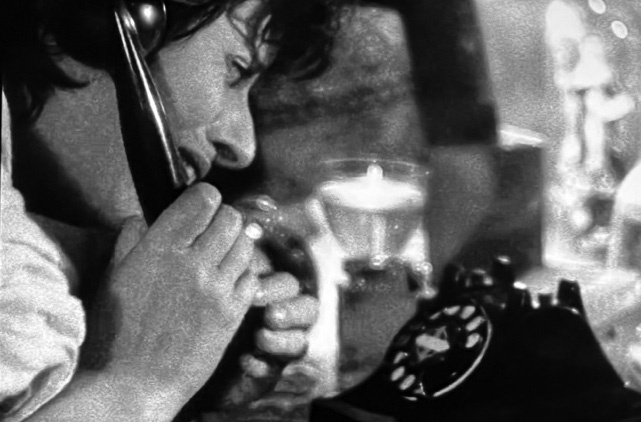
Una voca humana takes place in a single location, with a single character: Anna Magnani in the midst of a fraught one-way telephone conversation with a lover. An extraordinary sequence. These scenes (this scene) predict early- and mid-career Bergman. Would the idiosyncratic Master-Swede give this movie the time of day? Like Nabokov, he hated many of his equals. Ingmar would be repulsed, I believe, by the drawing of a comparison between a work like Una voca humana and the secular spirituality of early Antonioni. If Magnani had activated Rossellini's first act of modernist rebellion in Rome Open City, L'amore represents the major second.


With Il miracolo, Rossellini moves from inside to out, from torpor to vivification. Images of sublimity in the 'traditional' manner of the sublime build here, whereas in Una voca humana the sublime reveals itself less overtly.

The Magnani character, Nanni, somewhat daft, encounters on a hillside a man (Fellini) she perceives as St. Joseph. Two immediate clues of amissness: the resemblance of Joseph/Felliini with a faun; the presence of a wedding band on his ring finger. Nanni takes a couple draughts of wine, falls into a stupor; the man is gone when she awakens. She later takes her pregnancy to be an immaculate conception.

The dance between a universal love and an earthly love. "He took some bread and broke it." Pity the discourteous, test the naïve.

Modernism <=> naturalism. Nanni awakens surrounded by goats, the right side of her face illuminated by sunlight. The handheld backward traveling/dolly shot ascends the steps in the neighborhood. 

She sucks the water from the rocks. "Nanni, they're honoring you." Rossellini films Magnani the only way imaginable: with love. The church is closed to her, but the child is born. •


===

Writing on the films of Roberto Rossellini previously here at the blog.

Fantasia sottomarina [Undersea Fantasy] [1938]

La vispa Teresa [Lively Teresa] [1940]

Il tacchino prepotente [The Bullying Turkey] [1940]


Monday, February 05, 2024

Nana

An Unsung Masterpiece Rediscovered: Viewing Notes

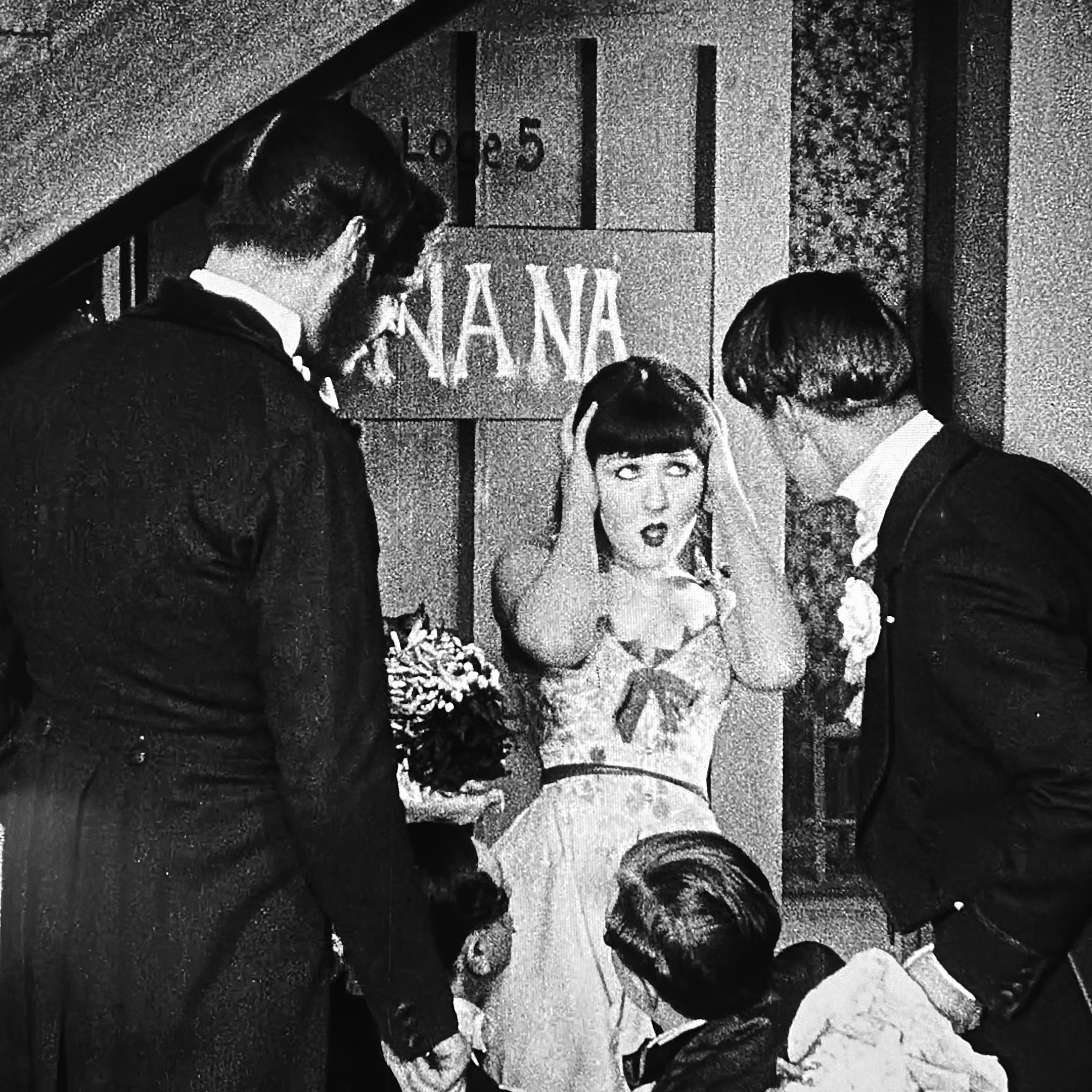
Adapted from Émile Zola's novel, this definitive movie version of Nana [Jean Renoir, 1926] is a masterpiece, the longest Renoir film, and restores one of the master's earliest successes to a length of 2 hours 49 minutes. What follows are some viewing notes from my recent revisitation of the film, 

-The lines of suitors, but with hierarchy.

-The hair on the comb-bristles.

-To liken one film to another usually you move from the later to the earlier. In the case of Nana, it's the opposite. It's absurd to call Shadows Cassavetes' Nana, but it makes all the sense in the world to all Nana Renoir's Shadows.

-Catherine Hessling as influence on Brigitte Helm.

-A flirt without abandon <–> archetype, Godard's Vivre sa vie. 

-The horselegs' galloping in closeup, shot with lateral cameras.

-Nana's tawdry chamber with the tinfoil curtains: life is an act. "Stillness Is the Move." Nana exudes kineticism.

-Impressive scene: Vaudeuvre's suicide. The mice will play in the servants' kitchen.

-bal –> balle

-Shot through with moments that can only be planned by one of the greatest of directors — Hessling drunk and being offered all the champagne. One second your eyes awaken, for a detail has snapped you back into focus.

-Muffat, the applauding crowd, and an indifferent assessor who passes through Muffat's frame twice.

-Smallpox: stand-in for syphilis. •


Other writing about Jean Renoir at Cinemasparagus:


===


Saturday, February 03, 2024

Fantômas

Louis Feuillade's First Serial Epic

Episode One: Fantômas

As Pedro Costa once put it, "A second is an hour in John Ford." We learned in the papers a few weeks back about 'units of time' being made up, perhaps, of (presently, experimentally) most-discrete 'bits': measurements have returned from recent scientific experiments that have gauged and validated the most detectable unit of time as a trillionth-trillionth of a second or shorter. 

Rooms confused, and nary a staircase to be found — the camera re-set-up from Set A to Set B; one might question the distance in time and spatial configuration between the successive Locations/Scenes, a cubist reconfiguration avant la lettre of Borzage's 7th Heaven.

A Feuillade* master-shot as conceived for the first time in Fantômas [1913-1914], perhaps even a lengthier two-shot, consists of 80% background: sometimes a mere drawing-room, and other times a majestic foyer, which exudes at once nefarious encroachment and menacing embrace or outright encumberment. 

* (for non-French-speakers: the director's name is pronounced "Fuh-YAHD.")

Episode Two: Juve contre Fantômas [Juve vs. Fantômas]

The sets (approximations of living-spaces, at the same time something elevated in Feuillade's, — or our own, — portray conception and perception of the land of the living), within the confines of cinema, run tangential to death. Two operations: the interiors and the exteriors forgo the scenes of different method of acting direction, vs. the stage... Despite the difference in degrees of control, Feuillade fills his interiors with just enough panache and gives over to a control of high necessity, whereas in the uncontrollable setting of the Parisian streets he films the action like a documentary. The two domains, according to Chabrol on a making of focusing on behind the scenes of La cérémonie. 

Episode Three: Le mort qui tue [The Killing Corpse]

Larger than life or Paris, a super-villain, 'a shadow o'er the land,' this nefarious figure Fantômas steals... pearl necklaces! Fantômas presents its eponymous make: larger than the actuality less changed than his battles would seem to suggest. The surreal dominates; as in all of Feuillade's movies: a zeitgeist inflection, and precursor to Lang's Dr. Mabuse, where the persuasive element here is the run-up to the Great War. Prophetic, in many ways a precursor akin to a reëxamination of Renoir's The Rules of the Game.

Fantômas fills so many 'posts' — Nanteuil the banker — and demonstrates the cruel action of step after step in the execution of a task — say, moving a trunk from one residence to another; in later films or those by other filmmakers this would be deemed unacceptable. 

Episode Four: Fantômas contre Fantômas [Fantômas vs. Fantômas]


Regularly throughout this film and subsequent Feuillade serials, there's a dreamlike mixing of the real and mise-en-scène... Actions take longer than they should; the editor holds the spectator trapped, camera motionless. Fantômas wields an autonomous control in part by and on Feuillade who directs the blocking and chooses his subjects.

The ending of this fourth episode's plumb crazy: Fantômas's pair of captors plunge into two perfectly dug holes covered over by dry grass! As though Fantômas had taken prior planning to ensure this trap down to the pinky-toe position...

Episode Five: Le faux magistrat [The Fake Magistrate]                                            


The earliest serial example of Feuilladean acting. The predictability of the aforementioned escape at the end of Episode Four. The shot angle predicts the occurrence.

In sum: Fantômas represents (all representation) the personification and straw-man of crime. •

===