"The Only Possibility of Survival Is to Pass Through Time"

Why an airport? It's simple enough to respond, "Because in a way the film's theme is 'transit'." And that's appropriate, especially the part about beginning a sentence with "because," because it's the stone in the shoe of every petty high-school English teacher, and as John Lennon once put it, "Time wounds all heels" — feel that sharp sting of memory. But before I get to Memory, I'll linger on Time. Airflight connotes transit not only in time (scheduled departure and scheduled arrival) and space (place of departure and place of arrival and the flyover between) but stasis at one with movement. The French have a special word for, not "duration," but the sense of duration: la durée. La Jetée [1962; the title translates to something like The Pier, which shares an etymological relationship with The Jetty, and refers in the literal sense to "la grande Jetée," or "the Main Pier," an observation (emphasis intended) platform at Orly Airport] incorporates so many ideas into its 28-minute runtime that it naturally stands as one of the great masterpieces of Chris Marker's hyper-storied career and thus one of the most philosophically profound — and sensorially pleasurable — films in all of cinema.
Sensorial? Stasis and movement, as I was saying: Marker in the opening credits refers to his film as a "photo-roman," or "photo-novel," a nod to the genre of 'graphic novels'-avant-la-lettre popular in Europe at the time, and which consisted of photographs, rather than illustrations, accompanied by captions and dialogue-bubbles relating a narrative in panel-format. (We've seen these publications in movies before, notably as the centerpiece of the plot in Fellini's The White Sheik.) La Jetée develops exclusively via a half-hour of still photos that nonetheless carry forward a speculative-fictional, sci-fi story — with one exception to the rule of stills, that is when one shot at the center of the film (concentric circles play a large part in La Jetée) springs to 'life' in a few seconds of moving-picture celluloid. More on this later.
Every photograph in the world exists as a moment captured in time, a memory seized, frozen. But suppose every photograph also represents a marker if you will: as the narrator (James Kirk in the English-voice-over version, Jean Negroni in the French-voice-over version) puts it, memories become remembrances [I'm assuming les mémoires and les souvenirs respectively, I've only ever heard the English-V.O.] because of the scars they leave. And when past and present overlap, it is what we call History. A man (Davos Hanich) in his childhood spotted a beautiful woman (Hélène Châtelain) on la grande Jetée; moments afterward, he witnessed a man get shot — "Only later did he realize that he had seen a man dying. — And soon afterward, Paris was blown up." Cut to stills of war-torn urban ruins. Is this an overlay of World War III with historical documents of Germany during World War II? In the aftermath (from childhood to adulthood) he has remained a prisoner to the "victors," "settled beneath the Chaillot, in a network of galleries," who in fact whisper to one another in the German language. As Orbital once sampled, "Time becomes a loop." The man is made the subject of an experiment "to throw emissaries into Time, to call past and future to the rescue of the present.... This man was selected only because he was glued to an image of his past," namely, the incident that took place on la Jetée. And so the man is sent back in time to the era of his childhood memory, where he encounters the woman once more. "They walk. They look at the trunk of a sequoia tree covered with historical dates. He shows her a point beyond the tree and tells her, 'This is where I come from.'"
And this is where the film intersects with one made four years prior: Alfred Hitchcock's Vertigo, esteemed by Marker as perhaps the greatest of movies. Hitchcock's picture informs La Jetée with its focus on Time, Obsession, the Irretrievable Past, Memory, Repetition, Dreams, and Death. (Not to mention a World of the Present Alien in Its Vibrancy; the only equivalent to which in cinema being Godard's examination and conflation of past, present, and future in 1965's Alphaville.) The man realizes, in the course of one of the "waves of time" that the experimenters send him back on to the time of his childhood, that the woman has likely not survived to the present following the nuclear holocaust. "She is dead." That these waves evoke ripples, reverberations, and henceforth the aforementioned concentric circles of the sequoia's cross-section, speaks to the relationship with Vertigo — the latter aspect an explicit appropriation from Hitchcock's film, in addition to a shot of the woman's nape with her hair swished up in a swirl, akin to Kim Novak's vortex/whirlpool bun in the earlier picture.
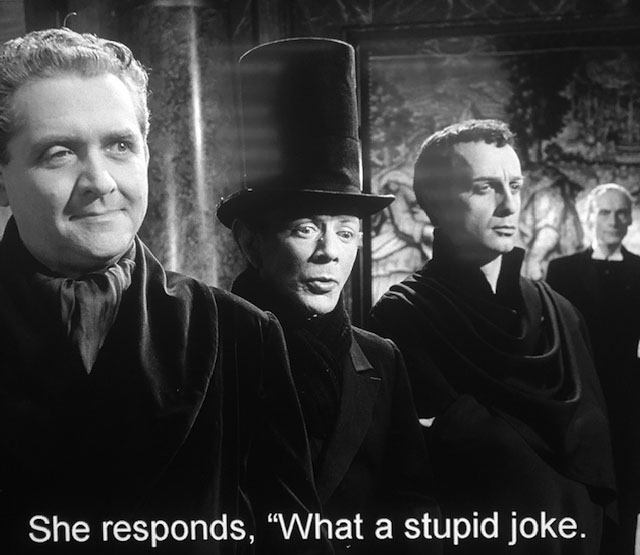
Following the success of the preceding travels to the past ("His childhood image had been used as a bait to condition him"), the man is launched into the future, where he meets a disembodied cadre of four men and women (presented in the staging of a cosmic black-mass, and predating by one year Astrid Kirchherr's photograph that adorns the cover of With The Beatles) in the hope that they will provide him some method of allowing the human race of the 'present' to persist. "Since humanity survived [hundreds of years in the 'future' — at least from the vantage of the man's 'present'], it could not refuse to its own past the means of its own survival. That sophism was taken for Fate in disguise." Indeed, all this past and present and future business ostensibly upturns the possibility of a stable temporal vantage at any point of existence. (Note: New memories of the new-past (via the man's time-travel excursions) make the era twice+ lived and therefore twice+ remembered.) Given the choice by the future-dwellers to reside in their epoch, the man makes a choice: "Rather than this pacified future, he wanted the world of his childhood, and this woman who was perhaps waiting for him."
But you can't go home again — at least in the common sense of the phrase.
When the man returns to the past he appears at la Jetée. He spies the woman — and himself as a child — "And when he recognized the man who trailed him since the camp [pregnant word for the network sub-Chaillot], he knew there was no way out of Time." As the hero speeds towards the woman, the individual who's followed him guns him down before the eyes of the young boy — who has seen "the moment of his own death." Fin. Except there is no such title-card.
Why does the man run? Out of elation for the permanence that awaits him (a happy life), or rather: the doom of impermanence (a constant loop from which there is no escape). In this sense, the 'futurians' providing aid when the survival of the race is assured would seem to make no sense, except (a) immediate relief is just that, and the survival of the individual being is far from certain; in any case, (b) the species' survival depends on their very aid. The man, an ex-soldier during the wartime, is but a guinea pig for the masters of war. No time paradox in the soldier's demise — simply, again, a traumatized pawn caught forever in a loop. Shifting presents, between childhood and adulthood, which is the past, which is the future...?
Back to paradoxes: I spoke earlier of the 'moving still.' Here is the woman framed in close-up, asleep, one photo dissolving into another, until finally we arrive at a moment whereupon "in glorious motion," her eyes flutter open, and she blinks but once —
The universal code for 'Yes'. •
===
(Footnote: In the opening credits, the word "Recherche" ("search") for one subliminal frame changes to the word "Trouvaille" ("discovery"). N.B. -ck.)
===
Other writings on Chris Marker at Cinemasaparagus:
Sunday in Peking [1956]
Letter from Siberia [1957]
Leila Attacks [2007] (posted in 2007, and including a note in the Comments from Chris Marker himself)
===