Silence and Its Metaphors

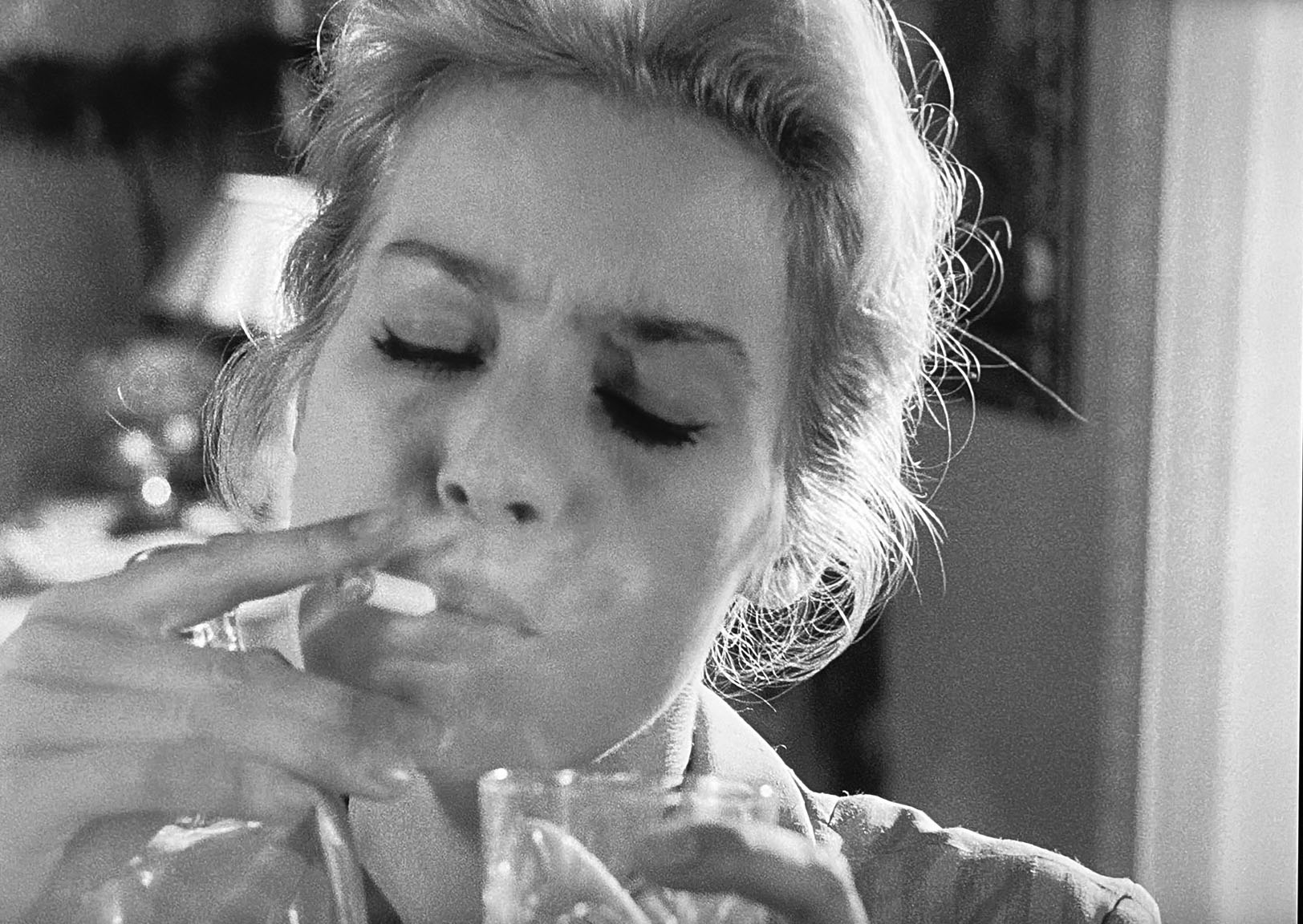
Just look at the images from Bergman's would-be chamber drama The Silence [Tystnaden, 1963] that nevertheless spirals into a kind of mini-epic, all outsized proportions (the proof is in the frames posted here alone), starring Ingrid Thulin as Ester, Gunnel Lindblom as Anna, and Carl Jörgen Lindström as Johan. The three take a train to an imaginary (doubly-meant) Eastern Bloc land for a couple days' vacation; the destination's government, in the meantime, is in the course of preparing for conflict with an undisclosed enemy, mobilizing tanks within and on the outskirts of the city (named "Timoka"). A couple days' vacation? To what end? A de facto sanitarium for Ester, a sex resort for Anna; on the whole, something like an avant la lettre "Holidays in the Sun." And as for "imaginary"? It's Bergman working in dream-mode — not too far off in fact from Fellini — but more on this later.
The Silence fits its very title not merely by the meagerness of dialogue (in his 2003 introduction to the film, Bergman states that there are around only 28 verbal exchanges within the film) but what the 'loss' of this sense portends: a heightening of the other senses. So we have a proposed God whose volubility is null, and thus deafening; and, at one with the searing imagery sculpted by Bergman and Sven Nykvist, the astounding tactility of the flesh. Johan and barebacked Anna take an afternoon nap in the hotel room, as Ester sashays about smoking and drinking spirits on a nebulous deadline for an uncited translation. Bergman places a finger on the scale in the first half of the drama, which would have the viewer sense the interplay between neuroticism and eroticism in the sisters' respective characteristic exuberances; but then he removes the gaming and it's clear that desire overwhelms, galvanizes, both of the women's existences. Like Mayim Bialik, Anna's not inclined to wipe off the back-beads of sweat while disincorporating mother-son boundaries; and much like Bohumil Hrabal, Ester is able to turn off the voices by masturbating herself to sleep in under twenty seconds. What is young Johan to do?
Wait. And wait. A strange third-wheel caught in his own Venn. Elfish gobetween of Mama Anna and Aunt Ester, he waits some more, in this oddball wilderland hotel with the Twin Peaks'y valet and a troupe of dwarves who leave the room-door ajar, and with whom he gets convivial, for are both parties in their own ways not stunted adults? Even though Johan takes a pee-pee in the hallway, remember that there were no (practical) surveillance cameras in 1963, nor back then did a boy have to act like a man and use a urinal. (Then again, I've known more completely unstunted men in the 21st Century who'd prefer rug to pissoir any day of the year.)
Three notes scribbled in the Moleksine: (1) "The server at the café who drops his change to smell Anna's knee under the table." (2) "Anna revolted by the couple making love in the box seat." (3) "One woman wants sex — the other, like all writers, thinks she's writing. Ester picks up Anna's dress and sniffs the crotch."
Anna is carnality. Anna has a love-affair with the waiter who sniffed her knee. Anna's ready sex is manifest in Bergman's frames, as tanks rattle in the street like garbage trucks. Anna unloads on Ester: "You can't live without feeling superior." Bergman has characters reveal background anecdote and psychology via another character's declaration referencing a a time outside (before) that presented in the film — cf. The Communicants, aka Winter Light.
Much talk has been made of the postulation that Ester and Anna are two sides of essentially the same unit-woman — this registers, but to an extent, we've been thrown into this film in media res. They're sisters, and thus connected/separated enough. But then in three years Bergman delivers Persona — and there is a different matter entirely. As I noted earlier, the film might be imagined — a purely theoretico-formal exercise, a hypothetical scenario. When the dwarves pass by, one can look, but one can't fully interact (otherwise one ends up in chantilly lace). In any case, Bergman himself resembles a hypnotist: a controller of time. For sometimes directors make a 'slow' scene, taking advantage of the temporality (la durée) of the medium to speed-down the movie. Take, for example, Anna recovering her bangles...
Perceived as a dream-fugue, the entire film depicts its own nondiegesis. With Johan and Anna having gone to find something to eat, Ester, alone, listens to the valet — strikingly, bizarrely, hanging out in her room, on constant call — wind his pocketwatch — in sync with a nondiegetic return of the ticking on the soundtrack over the opening credits.
No-one ever remembers the ending of The Silence. Essentially nothing happens or has happened — three people went abroad, drank, had sex, and return home. The tanks were as good as apparitions. A dream vacation. The film concludes with Johan reading a letter addressed to him by Aunt Ester — "words in a foreign language..." •




Other writing on Ingmar Bergman at Cinemasparagus:
Kris [Crisis, 1946]
Skepp till India Land [Ship to India, 1947]
Hamnstad [Port of Call, 1948]
Törst [Thirst, 1949]
Till glädje [To Joy, 1950]
Sommarlek [Summer Interlude, 1951]
Kvinnors väntan [Women's Waiting, 1952]
Sommaren med Monika [Summer with Monika, 1953]
Gycklarnas afton [Carnies' Twilight, aka Sawdust and Tinsel, 1954]
En lektion i kärlek [A Lesson in Love, 1954]
Kvinnodröm [Women's Dream, aka Dreams, 1955]
Sommernattens leende [Smile of the Summer Night, 1955]
Det sjunde inseglet [The Seventh Seal, 1957]
Smultronstället [The Wild Strawberry Patch, aka Wild Strawberries, 1957]
Nära livet [On the Brink of Life, aka Brink of Life, 1958]
Ansiktet [The Face, aka The Magician, 1958]
Jungfrukällan [The Virgin Spring, 1960]
Djävulens öge [The Devil's Eye, 1960]
Såsom i en spegel [As in a Mirror / Through a Glass Darkly, 1961]
Nattvardsgästerna [The Communicants, aka Winter Light, 1962]


