Bladder Cherries

Why do doubles still fascinate me? I suppose because of others' fascinations with the trope, and because they at once project the Self inside and the Self outside, — and because of all that goes with the stuff round the projection of the psyche, the impossibility of the mirror as a 1:1 phenomenon... We've heard it all before... And anyway I shouldn't say I'm 'fascinated' by the Double; that takes a lot but to consider it in the Feuilladean sense maybe it's fair use: let's say I'm 'mesmerized' when something happens within some form of this construct that brings it all back home to the double-crib, the twin in shadow, back to Hitchcock, Nabokov,... the latter's "poshlost"-nemesis Dostoevsky... In any case, the Double constitutes an axiom of the cinema: the master-shot, then two closer shots set 180º from each personage, in the construct's roughest permutation and most basic permission.
Time in Suzuki's Kagerō-za [Heat-Shimmer Theater, 1981] overlaid with time: an opening title card in English lettering that reads: "TAISHO 1926 TOKYO"; I'd presume to say no parallels are to be drawn between the eras in question — the Taishō era of 1912 to 1926, in which Japan launched into mostly-global contemporaneity; and Akihito's Heisei period of 1989 to 2019. The contrast is the thing: the pre-pre-war to the post-post-war, style or technique of 1981 teasing out the evidence of 1926 Modernism. A 'man who fell to Earth,' a man from nowhere, standing upright on some paving stones parsing a bridge, facing a stone staircase. An old woman offers him "bladder cherries" — from them, one can hear the cries of women's souls. She bears too a message for him, this Shunko Matsuzaki (Yūsaku Matsuda)... "You're hiding your true self." "My true self? Then get to know it."
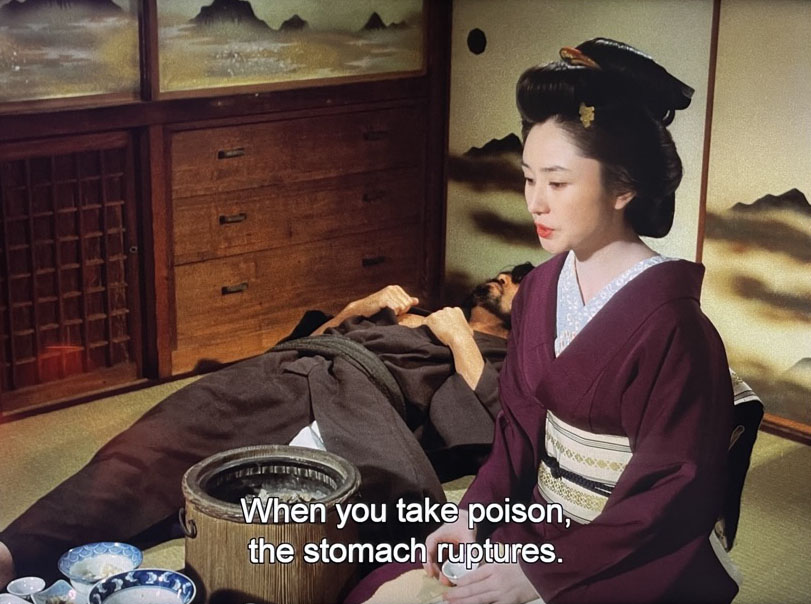
The other woman mentioned by Matsuzaki: Miyo (Mariko Kaga), Tamawaki's (Katsuo Nakamura's) maid before he left for Germany to teach literature (cf. Zigeunerweisen) — repeat encounter on the outdoor steps outside the hospital; Tamawaki's wife Oine (Eriko Kusuda) has passed away that morning... but "Irene" was her German name. Miyo explains: "He has two wives — the old one and the new one." Tamawaki, upon meeting Oine/Irene, "ordered her to become a Japanese woman"; he dyed her hair a sea-kelp blonde and "put dark lenses in her eyes" — dark as in blue; in other words he transforms her into a Japanese-made-ersatz-Aryan. "They tormented each other and one of them died."
The professorial look. New Orleans funeral music. Mrs. Tamawaki (Shinako, played by Michiyo Okusu) didn't write the letter to Matsuzaki, delivered in origami in Kanazawa; despite the identical handwriting, she asserts, before disappearing behind a revolving panel the rear side of which displays the painting of a demon.
Excuse the plot parley — in part Kagerō-za [Heat-Shimmer Theater] is intended to illustrate a response to: "Why is this deconstructivist film so plot driven?" The tension between the découpage and the execution represents Suzuki-classicism. Shinako Tamawaki: "If we never had to wake up, it wouldn't be a dream anymore." She leaves behind a a bladder cherry and a notebook inscribed with circles, triangles, and squares.
Looking up the dolls' kimonos moves the folds away from a concealed, internalized sex. "The flowers placed on graves are the most beautiful of all." Before Matsuzaki sleeps with her (Shinako/Oine), she intones, "My dyed hair cannot deceive the moonlight."
The play begins around the 1 hour 44 minute mark of the film and relays the tale of Tamawaki and his lovers and, by virtue of his stance as playwright, that of Matsuzaki. The brown palette begins to dissipate, replaced now with vibrant bloody reds, azures, and violets; cherry petals fall from the rafters, as in Ozu's A Tale of Floating Weeds. The ventriloquism of voices possessing bodies; the theater at last on cinema rather than the other way around.
"You simply must watch it." For there are many transformations before the theater collapses under the weight of its own psychic weight... or of the mass of bladder cherries which bubble to the surface in a tub. Matsuzaki's head is cropped in one framing by a ceiling beam.
Now as ancient and old. Nicolas Saada asked me rhetorically the other day, Will people still appreciate the movies signed Raoul Walsh? Let's add to that classical category the films of Seijun Suzuki. Both involve gunplay. Like a camera, a target is sought and locked upon. To whom does the responsibility lie, calling "Fire" in a crowded theater? •


===
8-jikan no kyōfu [8 Hours' Terror, 1957]
Ankokugai no bijo [Underworld Beauty, 1958]
Fumi hazushita hara [Trampled Springtime, 1958]
Akutarō-den: Warui hoshi no shita demo [Stories of Bastards: Even Under a Bad Star / Stories of Badboys: Even Under a Bad Star, 1965]
===