Renoir No. 1
(Prefatory note: If you're watching this in the recent Kino Blu-ray edition [or stream] made from the 4K restoration, I personally suggest turning off the volume on the Antonio Coppola score, and opting instead for any other accompaniment you might enjoy — Coppola's cheery piano-plunks don't synch so well with the tone of the film, in my opinion...)
===
"The caress of foliage in a boat with a friend." As quoted in Nick Pinkerton's audio commentary on the new Kino edition, that's the feeling that Jean Renoir wanted to convey in this his first film, La fille de l'eau [The Girl of the Water, 1925] (the French title is also a pun on "le fil de l'eau," i.e., "the water's line," that is "the current"). (The film has circulated for years in English-language territories and now again on the 2021 Kino release as "Whirlpool of Fate.") In some ways it's the primeval Renoir sentiment. Was it Bazin or Truffaut who said that Renoir is like a cork floating atop the water?
Strolling along a towpath with a horse led by reins, a young girl, Gudule (Catherine Hessling, Renoir's love and muse at the time), guides a barge through a canal. Moments hence, before the dramatic nighttime recovery of her father's body inexplicably gone overboard in the water (one of two odd disappearances here), the film is clearly legible as a precursor to Jean Vigo's supreme 1934 L'Atalante, what with Uncle Jeff (Pierre Philippe), as though ploddingly underscoring the principles of Relativity, walking the length of the drifting barge while the background appears to remain stationary. Jeff (spelling in deliberate English according to the French intertitles) is the father's brother, a brutish incestuous uncle, who becomes the grand poobah after the burial of his sibling Marc, on the conclusion of which ritual he enters a nearby saloon to hold court in a scene mettait en scène like the early reelers by Arbuckle and Keaton. He will terrorize Gudule as the film progresses. In the meantime, the barge is put up for sale by the "Justice Authority," represented by a character resembling Harold Lloyd — one internal-half of whom is Wallace Stevens during working hours in Hartford.
(Sidenote 1: There's un fil de l'eau that stretches from Renoir's La fille de l'eau, to Vigo's L'Atalante, to Laughton's The Night of the Hunter, and on to Carax's Annette of this year.)
(Sidenote 2: Previous editions of La fille de l'eau on DVDs from StudioCanal and Lionsgate carried a 70-minute version; this new restoration might add some missing elements, and also elongates the runtime due to a different frame-speed, so that it plays at 83 minutes.)
Renoir's picture uses every trick in the silent-film-cabinet, in two sequences especially: Uncle Jeff's attempted rape of Gudule; and Gudule's dream sequence.
First the former: Matted shot of Jeff's eyes on his niece. Close-up of Gudule's face out-of-focus as Jeff closes in. Rapid cuts (intercutting with the barking dog who senses alarm from the barge deck) as Jeff beats Gudule for refusing his advance. Gudule is saved by a passer-by on the towpath and escapes to shore... while the passer-by shares a chuckle with Jeff... Down with the patriarchy or what?
Soon upon her escape la Fouine ("The Weasel") (Maurice Touzé) spots her from up in a tree ("le garçon de l'arbre" as opposed to "la fille de l'eau") where he says he's "hunting." Human beings cannot give up their familiar animality, at least here in the countryside, where la Fouine takes caravan-residence with a mother? grandmother? an aunt? in any case someone named la Roussette ("The Bat") (Henriette Moret).
Picking up from the paragraph before the above: we also have the silent Gag exploited, as M. Raynal (Georges Térof), automobile-owner-of-the-village, leans back on a precarious balcony rail, not paying any heed to the would-be-imminent catastrophe, as he gives high marks before the tenants of a building he owns in town. Raynal's son Georges (Harold Lewigstone) is neither to be confused with Georges Térof nor The Weasel la Fouine nor the rich farmer, Justin Crépoix (Pierre Champagne) — he of the noble rich, who breaks up a dispute between la Fouine and a bicyclist. (Gudule's dog knocked the latter over.) —
— What happens to Justin after this scene? —
Anyway. There's not just a fire. There's "a Gypsy attack!" No, these hayfires are — What was that again?
They were set by la Fouine out of vengeance for the treatment of his assistant and lovely 'older sister.'
Raynal's offer to use his auto to quell the fires is "naturally rejected" particularly because the arson is... ten yards away from the lot. He marches out with the firemen nevertheless — more courage in the realm of the haute-bourgeoises, to which Renoir would attest to the end, in all relevant exceptions that proved the rule. A tracking shot across the pompiers' faces.
Pierre Renoir, Jean's brother and so Pierre-Auguste's son, appears among the fire-dousers with a scythe.
Incredible shot: Hessling will walk into the frame from the left — a pure provocation, an amateur entrance; the camera's already locked for this movement.
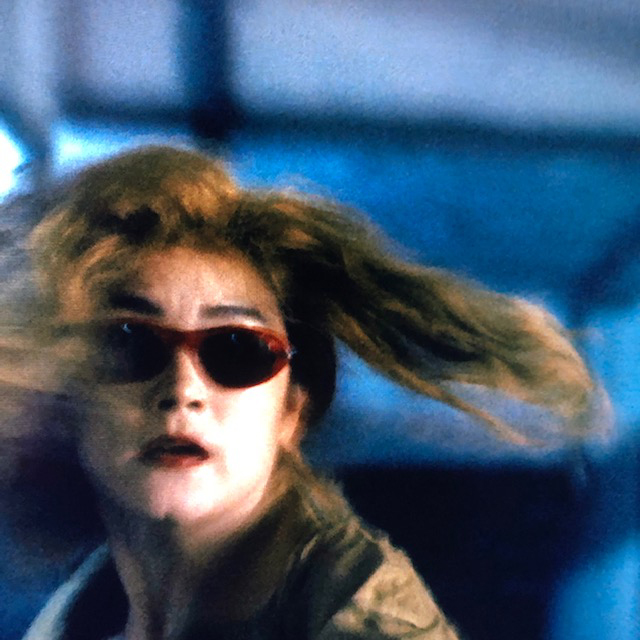
The most virtuosic portion of the film involves Gudule's nightmare sequence in the forest rain when she's struck by fever: double-exposure; slow motion; blown-out film; animation lightning bolts; backwards trick photography; 'appearance' (out-of-nowhere) cuts; superimpositions; camera tilts for SFX to make figures 'walk on walls'; tricks of scale (the lizard wandering the corridor); distorted images (via reflections in a mirrored sphere); 'flight' accomplished by rear projection and superimposition...
End of Tale: Gudule is taken by Georges to the Raynals to convalesce. On her way to the market she's robbed by wooden-clogged Uncle Jeff; he extorts her again, Georges overhears, they brawl, Jeff gets knocked downstream...
A film fabricated of water and clay, spun, spun like a ceramic. •
Other films by Jean Renoir covered at Cinemasparagus: