Saturday, April 30, 2022

The Flight of the Phoenix

"The Little Men with the Slide-Rules and Computers Are Going to Inherit the Earth"

+

The Wrong Brothers

+

Shit Burning Man


A Robert Aldrich failure, 1965. The least interesting take on Hitchcock's 1944 wartime masterpiece Lifeboat. Burdened by terrible performances, with the exception of (an admittedly one-note) James Stewart, Dan Duryea (underused), George Kennedy (underused), Peter Finch (underused), and a German named Hardy Krüger. Too many Brits make up the cast, "old chap," in far lesser locomotion than Aldrich's very good UK-set two-minutes-shorter-than-2-hours-22-minutes The Killing of Sister George of 1968, and they do what white Britons (except for The Beatles) always do in movies: nothing (that's a Godard paraphrase) or, rather, emote like pigs. There are some beautiful shots of dune-trudging. (Porcile?) Otherwise you're made to watch a group of sub-Hawksian monotones join together like the males they are and perform some incomprehensible and wildly inauthentic shit to an airplane (chartered by "ArabCo," intended destination Benghazi) in order to let it take flight again, for a distance that finally seems to have been a half-mile: obviously "the Phoenix" is going to fucking fly, as was evident from the first second of the imminent disaster. 

Krüger says to Stewart: "You behave as if stupidity was a virtue." Hence, no Thunder Bay [Anthony Mann, 1953] or The Spirit of St. Louis [Billy Wilder, 1957] — instead, The Flight of the Phoenix.

===

Other writing about Robert Aldrich at Cinemasparagus:


===

The Last Sunset

"Do You Like God?"


The opening doubles Aldrich's double-play in Vera Cruz of 1954: O'Malley (Kirk Douglas) and Stribling (Rock Hudson) ride in successive shots through a mountain pass; as Douglas says later, "This fellow and I are kind of bound up with one another." Indeed: Hudson is a sheriff with a warrant out for Douglas's arrest on account of his killing his brother-in-law. The script by Dalton Trumbo (his second collaboration with Douglas since getting out of Blacklist-jail with Kubrick's 1960 Spartacus) and Aldrich takes a deeper burrow into what we might deem the 'psychological western' than in Aldrich's previous Vera Cruz with different scriptwriters and a different sensibility on the part of the director. Here there are prolonged scenes of dialogue and mutual-moistening, that buck the horse-code: movement / chat / movement / chat. It all takes place under wide-open outdoors. Everything bleeds under the blue Arizona skies: "Women like that [Miss Breckenridge, i.e., Dorothy Malone] ... are worth $1500 apiece, delivered to a Dutchman in Vera Cruz."

Douglas later learns that "Missy"/Melissa (Carol Lynley) with whom he falls in love out of half-spite for Hudson's advances on Malone — Missy is a double of her mother Malone, and 'worth one-fifth of the cattle in the cattle-drive' — is his daughter... according to Malone. 

"God has a special love for drunks, and fools, and children just like you."

Welcome in 1961 to the post-Mann psychological western, in which Rock Hudson / Stribling is portrayed as less intellectual and complicated than cunning Kirk Douglas / O'Malley, whose production company Brynaprod put this movie into motion.

===

Friday, April 29, 2022

Vera Cruz

Some Words from My Sponsor (François Truffaut)

Robert Aldrich's violent 1954 film (the hand-made titles signify washes of blood) was the second western shot by (Harold) Hecht-Lancaster Productions, made possible by the success of their first collaboration earlier in the same year, Apache.

I'll use this space only to suggest you seek out Truffaut's 1975 collection The Films in My Life [Les films de ma vie] for the critic's precise 22-point breakdown in 1955 of Roland Kibbee's and James R. Webb's adaptation of Borden Chase's story. I'll quote a paragraph that follows this plot synopsis:

"Vera Cruz is built on the repetition of themes: two encirclements by the Juaristas; two thefts of the same loot; Cooper saves Lancaster's life and Lancaster Cooper's. I have left out the role of Nina, which is perfect: a) she is caught by a bandit's lasso; b) Cooper frees her by catching the fool with his lasso; c) Nina thanks Cooper with a kiss on the mouth d) during which she steals his wallet; e) as he starts to leave, she offers him an apple; f) he starts to reach for his wallet to pay for it, and g) she tells him "Don't bother; it's free"; h) later, they meet and Cooper scolds her for stealing his wallet. "Have you looked carefully for it?" He finds it in his pocket. It's Nina who brings Cooper to the Juaristas. In the next-to-last scene we see them walking toward each other. We don't see them in the last scene."

Truffaut concludes: "Some of [my colleagues], understanding nothing at all of [Vera Cruz], denounced it as pompous and childish. It was Victor Hugo who asked, "Who are all these children, not one of whom knows how to laugh?""

===

Other writing about Robert Aldrich at Cinemasparagus:


===

Three Women

Not the Altman

Three Women [1924] by Lubitsch is not so very odd — a paramour invests a rich widow's money, then lives for a period off it, high-hog. He lavishes attention on her daughter Jeanne, pronounced the American way presumably since she's also "Jeannie," and since this is America... Porcine post-Berlin fellow whom he owes money to recognizes the subterfuge... and approves as chances are he'll be paid back... The scoundrel-paramour marries the daughter to the chagrin of the mother, and of the daughter's Berkeley sweetheart... Soon afterward he enjoys the fruits of Jeanne's trust-frund and he takes on a harlot'ish lover, Harriet...

Decor you can touch, doors you can open, guns you can shoot. It's a Lubitsch melodramedy.

===

Other writing about Ernst Lubitsch at Cinemasparagus:


===

Thursday, April 07, 2022

LICORICE PIZZA in the Cahiers du cinéma


From the January 2022 issue of the Cahiers du cinéma, no. 783.

===

PALE AND BLUSHING CHEEKS

by Jérôme Momcilovic

translation from the French by Craig Keller


Making use of roads off the beaten path, to say nothing of the birth of a love affair, Licorice Pizza leaves you in a state of gentle, and paradoxical, amazement. Gentle because the gentleness of the film itself, come to fruition in The Master, Inherent Vice, and Phantom Thread, but fully unthreading here, beneath the guise of a light and vintage romance, with a novel and nurturing limpidity — dare we use that cliché of film distributors: we’re happy just to get it out there — light, recognizable. Paradoxical because there’s so much here that is absolutely staggering, from the mastery of a filmmaker assertive as never before of his actions, or of the disarming simplicity that’s become his horizon-point. It’s also the fact that, as in his three preceding films, Licorice Pizza takes off without having totally pierced the aura of mystery that has by now surrounded, in varying degrees, the films of Paul Thomas Anderson.


A dense mystery, permeating like a fog or a state of intoxication (The Master, Inherent Vice), or even a tiny mystery perceived beneath the form of a light perplexity at the film’s conclusion — what did we just see? have we already seen it? (Phantom Thread, Licorice Pizza): the feeling in each case is that the characters are living a life perfectly independent of the spectator. It has, rather, been regulated by the grand American cinema to feel exceedingly present despite the film’s intentions, incubated by them, pampered by the spectacle — entertainment: “mission to interview,” Daney said. Charming without playing the smooth-talker (difficult without being so, what with the similar sets, costumes, music-cues), Licorice Pizza panders to no-one, no single eye: it takes to the roads that sing its song, and its slightly communal grace owes much to this impression that it is animated by nothing other than its own pleasure in watching what it watches, and in showing what it shows.


What does it show with so much joy and sweetness? Above all two superb characters: a boy and a girl all at once golden and banal, brought together by an amorous urge complicated by a slight, but decisive, age difference. Gary (Cooper Hoffman) is still a high-school student, so the few years separating him from Alana (Alana Haim) provide slim chance for advances that he eagerly throws her way as soon as he meets her and the film starts, in the courtyard of the high-school where Alana has come for the day to assist with school photos. If the urge is called to triumph all the same, it’s that in reality each of them is feeling the other one out with their ages serving as an offbeat sticking-point. Gary’s sixteen years keep him in school, and are often betrayed by things like his chubby figure and light-hearted mood, but a singular spirit of initiative makes of him an already very accomplished man, leading in his spare time a double career as actor and seasoned entrepreneur. On the other hand, Alana breaks down the doors of adult life, held back less by immaturity than by a precocious tendency toward disenchantment.


Here we find an insistent motif in PTA’s cinema, that in which the fiction of the couple apparently plays a classic role of reconciliation between opposites, in order to organize between the two parties a perpetual transfer of traits and positions, an elastic rapport with unforeseeable combinations, reaching for a meeting-point that’s less than safe. Sometimes the point of harmony ends by being found (the complicit pact that closes Phantom Thread); sometimes the film opts for regret and sentences the two parties to their tragic fate as asymptotes, each one drifting out on their own sea, their own astrological trajectory (The Master, Inherent Vice). Licorice Pizza belongs to the first category: it’s there from the first scenes, from Gary becoming smitten with Alana, her long skinny legs and her sardonic grin.


Here then is a second point in common with the most recent Tarantino: Licorice Pizza, like Once Upon a Time… in Hollywood, believes in destiny. The first point in common is obviously the era, the set-design, which, around Hollywood in the early ‘70s (1969 for Tarantino, 1973 for PTA), was the environment of the early childhood of the filmmakers. Like Tarantino’s film, Licorice Pizza at moments floats in a soft and exhilarating irreality. This isn’t just a matter of the colors, suitable to Los Angeles and the ‘70s. In this respect, Inherent Vice markedly pushed the trip farther, but that was a ghost movie, whereas Gary and Alana are vibrantly alive — singularly alive. It’s also a matter of the strange population that resides within this movie-world neither entirely on the side of reality nor entirely on that of fiction: relatively unknown actors, workers in the shadow of the movie industry, that the two films gaze upon with the same amused tenderness.


But let’s come back to destiny. Once Upon a Time… in Hollywood created an unflinching and very moving interpretation of destiny. Since destiny, the film seems to say, is by definition that which must arrive, all there is to do is wait. Await, in the company of the characters, the rendez-vous that fate has fixed for them; wander about in the time of the film; rove about in the era and the setting; kill time to watch. Licorice Pizza leaves a neighboring but sensibly different impression. Its incessant divagations (stories of waterbeds, pinball machines, trucks hurtling through the Hollywood Hills to the point of no return and in reverse: all things pleading in the name of the film for an uncontrolled moment) seem so many unexpected detours, screwball bifurcations, but we can’t really say, once the end-credits roll, if they’ll have mattered much given the dénouement of the story. The films directed by PTA since The Master all have the same atmosphere of cubist odyssey: one comes away with the impression of having taken a grand voyage, but the itinerary remains opaque. The hand of destiny has been displaced, henceforth unable to be found on the surface instead allowing his œuvre to take seed at the subterranean level of the narrative. It suffices here to pay attention to the lyrics of “July Tree,” Nina Simone’s sublime song that accompanies Gary and Alana’s meeting: seeds of love have been planted, it’s enough to wait two seasons. It’s a touch more time than is required, in fact, for the story of Licorice Pizza to reach its goal.


This strategy of diversion has several advantages. In placing his films under the sign of Uranus, “the planet of big surprises” (Inherent Vice) offers of destiny a representation otherwise more inventive than that of his first films (Boogie Nights, Magnolia, Punch-Drunk Love) in which, by way of confusion between fate and cinema, and with the excuse of being young and virtuosic, he vainly exhausts himself on a puppet theater. To allow destiny to do its subterranean work, lodged beneath the skin of the narrative, which deals on the surface with waterbeds and pinball machines, is for PTA’s cinema to treat itself to two things. First, a powerful emotional vector — this is what the immediate perception indicates: these four most recent films have jaw-dropping endings. Second, and foremost: a liberated period to watch its characters, and so then its actors.


PTA believes that Licorice Pizza owes almost everything to the faces of its two young actors, Alana Haim and Cooper Hoffman. The pleasure that he took in filming them is evident. And we’d be brushing over the essential matter if we didn’t emphasize that these two faces are new to the cinema, and the pleasure of filming them comes across in being the first one to have done it. Just like the twists and turns of the scenario are sewn together from anecdotes told by PTA’s entourage, this daring casting (two young unknowns with imperfect faces, while in the background of the scene such actors as Sean Penn and Bradley Cooper content themselves as apparitions) was already at hand: Alana Haim performs in a band founded with her two sisters who also play roles in the film; as for Cooper Hoffman, he’s the son of Philip Seymour Hoffman — PTA saw him grow up alongside his father, who died in 2014, having shot five films with him.


With this radical and radiant choice, combined with the fact that PTA, having remained faithful to celluloid film, is here as in Phantom Thread as his own director of photography, Licorice Pizza goes all the way to the end of a direction that is slowly digging itself further inside his œuvre. The most recent films can be seen as affirming themselves in a very distinct taste for faces, and adjacent to them, an interest for pale skin in which emotion betrays itself when the blood hits the cheeks — already, when PTA lands on such decorated actors as Philip Seymour Hoffman, Julianne Moore, Amy Adams… With the diaphanous visage of Vicky Krieps, Phantom Thread made a veritable theorem out of this preference when it came to the mise-en-scène, from which Licorice Pizza inherited an eloquent precaution: no longer that this would-be unknown face would go flush from the first appearance of the characters; those of Alana Haim and Cooper Hoffman sported no make-up on set. It’s because there’s something to see here that cosmetics would have masked: not so much the skin itself as a trembling emotion in arrays of pink just under the surface. It’s here that the seeds of love grow in silence, here that resides the trembling beauty of Licorice Pizza: beneath the rosy cheeks of Cooper Hoffman, who has his father’s pale skin.


Thursday, March 24, 2022

"Rolex Laxative"


These are the lyrics I penned for the opening track on an album I'm writing. More to come.

===

Rolex Laxative


Kern County time moves a wholly different pace

Cosines alone can’t chart residents’ space

Airport Café and the Five Finger Pub

Exercise their lottery rights, and there blow the rub

Do a double-take at the Brewery as I believe that’s the guy

Who’s the multi-instrumentalist of Hundred Digits of Pi


A teachable moment

The Great Emancipator

I had a dream as an omen

On her graphing calculator

Kernites exercise their watery rights


Could’ve sworn I dialed 3-1-1 a long time ago

One plank creaks while the others don’t

McNally’s Outpost and the Pizza Barn

A “Steal Your Face” sticker spins sticky yarn

Charting her course in seconds, cosecants

Garbage bag fragrance and indifferent sequence


A teachable moment

One hand dangling free

Drawstrings are drawn open

To chuck that disused tambourine

Kernites exercise their watery rights


Behold the spirits milked from the net-entangled dairy-deer

Believe it or not, you’ll never find a ride-share here

Buy fish-market jackal-meat then perfume it with make-up

Even dumb-bell Lake Isabella dogs can sense a break-up

It’s all true about me in California with an Arizona tag

On the way I re-rigged Peter Frampton’s tubes for colostomy bags


No bombs will ever fall on Kern

Will ever fall on Kern

Never-ever

Never-ever


Writing well is the best revenge

Is the best revenge

For what you want

For what you want


Evidence of my single hike proves my proactivity

Flexing my tendons and choking on reflexivity

The neighbor’s lights at night lend dimension to the space

Rolex laxative

Rolex laxative


The radiance

The radiance


===

Wednesday, January 26, 2022

Vitalina Varela - A Text by Yannick Haenel

VITALINA VARELA

by Yannick Haenel

2022


(translated from the French by Craig Keller)


My friends, before it leaves the big screen, rush to see Pedro Costa’s Vitalina Varela: this is very important. We can all agree: the cinema in its near totality has turned to shit, is soulless, has sold out to that hysterical movie-trailer factory which only produces images of our tolerance for junk. But a few filmmakers find unscathed images: images that, through their political dignity, through their poetic rectitude, cut themselves off from tawdry hell; among these filmmakers, there is Pedro Costa.


Vitalina Varela deboards a plane barefoot. A chorus of cleaning-women inform her that she’s arriving too late; her husband has been buried three days prior. “Go back home,” the chorus intones. But Vitalina Varela was waiting for more than twenty years in Cape Verde for her husband, emigrated to Portugal, to send her a plane ticket. She’s here, and she’s here to stay; she’ll reside in the dead man’s house; will enter the unveiling of this darkness that grips Cova da Moura, that gerry-rigged poverty-stricken neighborhood on the outskirts of Lisbon, which seems a necropolis. 


The roof is rotting, the door won’t close all the way, men walk inside without knocking. Vitalina Varela gets dressed at nighttime; the whites of her eyes tear through the darkness: anger is a form of resistance.


Between life and death there opens a gap where pain speaks. This is where it all takes place: cinema is possible here, like poetry. A knife comes closer to our throats at every instant: we are expendable; the women and men escaping execution are devoted. After Buchenwald and Dachau, Robert Antelme had this to say: “We can no longer tolerate being touched; we feel ourselves to be sacred.” Vitalina, since her period of mourning and her revolt, is sacred — separate: she speaks to the dead, to her dead one. 


Those women and men who have been sacrificed by Western horror, the victims of colonial dump-off, like the Black workers from Cape Verde such as Vitalina, live at the heart of this chasm in which light and dark tear themselves apart. Pedro Costa films from this darkness that is the state of sacrificed light; and all the splendor of the film comes from the arrivals of light that deliver themselves from the dark background. When the heart thinks, darkness vanishes into thin air. A different house is constructed in the blue pleasure of the mountains. Repairing the roofing is an act of love.


A sick and trembling priest, whose church has been abandoned, tells Vitalina that the world has broken since Judas’s kiss. The cheek he kissed remains obscure: “It’s from these shadows that we’ve been made,” he says. But the nocturnal density enveloping Vitalina’s body in her house lends her an aura: she belongs to the light of the other cheek: that which has not been touched by Judas. It’s the radiant cheek: its light is the political force that gives back life to the sacrificed. •


===

Sunday, January 02, 2022

Ancestral Teacher of a Generation (aka The Grandmaster)

Stand and Deliver

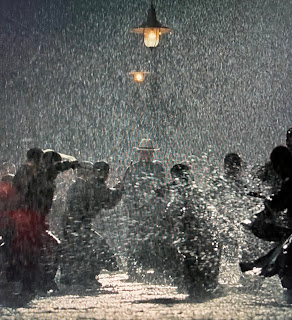
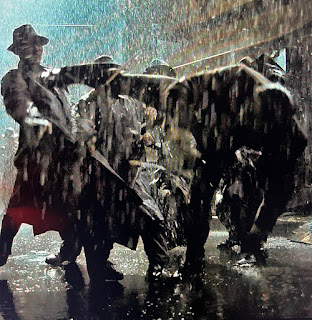
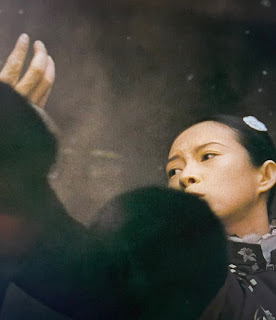
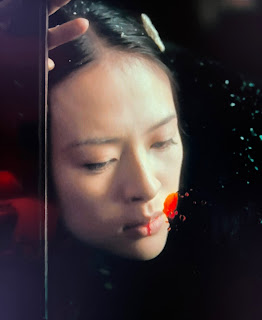
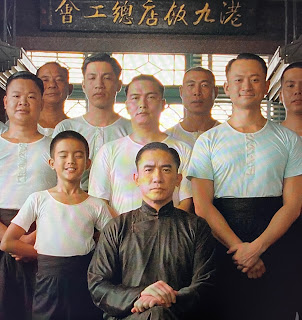
Horizontal; vertical: Those are the two characters that make up the word "kung fu," as we are told by Ip Man (Tony Leung), the real life martial arts master of the wing chun style and eventual mentor to Bruce Lee. Ancestral Teacher of a Generation [Yi dai song shi, also known as The Grandmaster (its English title appears at the end of the credits), 2013] exists in three different cuts of various lengths and unique content: a Hong Kong cut, an American cut (presided over by Harvey Weinstein, with Wong's supposed sign-off), and the domestic Chinese cut, which is the longest and, according to those who've studied all three versions, the richest. As Wong mastered the wuxia with Ashes of Time, so too in The Grandmaster does he present the most exciting kung-fu-movie-cum-dynastic-epic in years. But whereas Ashes of Time made jaw-dropping use of a lysergic color palette, The Grandmaster is all blacks, beiges, silvers, and whites — the falling rain 'steels' the image in this story that spans the 1930s to the '50s. Lessons:

"A bird that has no perch to sit on." — We've heard this phrase before, in Days of Being Wild

"I have two hands, but wing chun has eight kicks."

"A tiger never quits the mountain."

"As life as in chess, a move once made stays on the board."


===

The Books I Read in 2021


My Brooklyn Writer Friend

by Greg Gerke

2015


Let Me Tell You What I Mean

by Joan Didion

2021 (1968-2000)


Small Fry

by Lisa Brennan-Jobs

2018


Holzfällen

[Timber-Felling]

by Thomas Bernhard

(translated by David McLintock)

1984


Nicholas Nickleby

by Charles Dickens

1839


Balloon Pop Outlaw Black

by Patricia Lockwood

2012


No One Is Talking About This

by Patricia Lockwood

2021


Once Upon a Time in Hollywood

by Quentin Tarantino

2021


See What I See [Expanded Edition]

by Greg Gerke

2021


Harmonium [Second Edition]

by Wallace Stevens

1923/1931


Harlem Shuffle

by Colson Whitehead

2021


A Swim in a Pond in the Rain: In Which Four Russians Give a Master Class on Writing, Reading, and Life

by George Saunders

2021


Images en parole

[Images in Words]

by Anne-Marie Miéville

2002


Caderno de rodagem: ‘Vitalina Varela’

[Shooting Notebook: ‘Vitalina Varela’]

by Pedro Costa, et al

2021


Fear Stalks the Land!: A Commonplace Book

by Thom Yorke and Stanley Donwood

2021


The Haitian Chronicles

by Douglas Turner Ward

2020


“A Christmas Carol” and Other Christmas Writings

by Charles Dickens

1835-1854


The Old Curiosity Shop

by Charles Dickens

1841


===

Saturday, January 01, 2022

The Films I Saw in 2021

First Seen of the Year: ‘Salut les Cubains’ [Salut, Cubans / Here’s to the Cubans] [Agnès Varda, 1964]

Last Seen of the Year: ‘Unconquered’ [Cecil B. DeMille, 1947]


===


Die 1000 Augen des Dr. Mabuse [The 1000 Eyes of Dr. Mabuse] [Fritz Lang, 1960]

2046 [Wong Kar-wai, 2004]

À bout de souffle [Breathless] [Jean-Luc Godard, 1960]

L’albero degli zoccoli [The Tree of Wooden Clogs] [Ermanno Olmi, 1978]

All I Desire [Douglas Sirk, 1953]

Les amants du Pont-Neuf [The Lovers of the Pont-Neuf] [Leos Carax, 1991]

The Amazing Plastic Lady [Martin Bell and Mary Ellen Mark, 1995]

Andrey Tarkovsky. A Cinema Prayer [Andrei A. Tarkovsky, 2019]

Annette [Leos Carax, 2021]

Ansiktet [The Face] [Ingmar Bergman, 1958]

Anticipation of the Night [Stan Brakhage, 1958]

Anvil: The Story of Anvil [Sacha Gervasi, 2008]

Apache [Robert Aldrich, 1954]

Apocalypse Now {Final Cut} [Francis Ford Coppola, 1979/2019]

A propósito de Buñuel [Speaking of Buñuel] [José Luis López-Linares and Javier Rioyo, 2000]

Arsenic and Old Lace [Frank Capra, 1944]

Attack [Robert Aldrich, 1956]

Auteur on the Campus: Jack Arnold at Universal! [Daniel Griffith, 2021]

Battling Butler [Buster Keaton, 1926]

The Beatles: Get Back [Peter Jackson, 2021]

The Beatles: Let It Be [Michael Lindsay-Hogg, 1970]

Beau travail [Nice Work] [Claire Denis, 1999]

Beeswax [Andrew Bujalski, 2009]

Being the Ricardos [Aaron Sorkin, 2021]

Bergman Island: Ingmar Bergman on Fårö Island Cinema and Life [Marie Nyreröd, 2004]

Beyond Therapy [Robert Altman, 1987]

Il bidone [The Swindle] [Federico Fellini, 1955]

Bijo to ekitai-ningen [The Beauty and the Liquid People] [Ishirō Honda, 1958]

The Black Cat [Edgar G. Ulmer, 1934]

Black Panthers {English-Language Version} [Agnès Varda, 1968]

Blonde Cobra [Ken Jacobs, 1963]

Blow Out [Brian De Palma, 1981]

The Blues Accordin’ to Lightnin’ Hopkins [Les Blank with Skip Gerson, 1968]

The Boat [Buster Keaton with Edward Cline, 1921]

Le bonheur [Happiness] [Agnès Varda, 1964]

Bride of Frankenstein [James Whale, 1935]

Bringing Up Baby [Howard Hawks, 1938]

Broken Lullaby [Ernst Lubitsch, 1932]

Brother to Brother [Rodney Evans, 2004]

Bullfighter and the Lady [Budd Boetticher, 1951]

Bu san [Inseprable Bonding] / Good Bye Dragon Inn [Tsai Ming-liang, 2003]

Capitalism: Child Labor [Ken Jacobs, 2006]

Capitalism: Slavery [Ken Jacobs, 2006]

Cet obscur objet du désir [That Obscure Object of Desire] [Luis Buñuel, 1977]

Le charme discret de la bourgeoisie [The Discreet Charm of the Bourgeoisie] [Luis Buñuel, 1972]

Chaval [Mario Ruspoli, 1971]

Le Chavalanthrope [Mario Ruspoli, 1972]

Cheun gwong tsa sit [Spring Light Bursts Forth] [Wong Kar-wai, 1997/2021]

Chung-hing sam lam [Chungking Jungle] [Wong Kar-wai, 1994/2021]

Cinema 70 n.5: Luchino Visconti [Marcella Curti Gialdino, 1970]

Cinema senza tempo: Giulietta Masina, la forza di un sorriso [Timeless Cinema: Giulietta Masina: The Power of a Smile] [Sandro Lai, 2006]

Les cinq cents balles [Five Hundred Bills] [Melvin Van Peebles, 1961]

Citizen Kane [Orson Welles, 1941]

Clorae and Albie [Joyce Chopra, 1975]

College [Buster Keaton, 1927]

Colorado Territory [Raoul Walsh, 1949]

Commuters [Claudia Weill and Eliot Noyes, 1970]

Conjuring the Rolling Thunder Revue: A Bob Dylan Story [Martin Scorsese, 2019]

Crash [David Cronenberg, 1996] 

Creature from the Haunted Sea [Roger Corman, 1961]

Les créatures [The Creatures] [Agnès Varda, 1966]

Cristo si è fermato a Eboli [Christ Stopped at Eboli] [Francesco Rosi, 1979]

Curb Your Enthusiasm: Season 10 [Larry David, et al, 2019]

Daguerréotypes [Agnès Varda, 1976]

Daguerreotypes, objets photographiques [Daguerreotypes: Photographic Objects] [Agnès Varda, 2005]

The Damned (Götterdämmerung) [Luchino Visconti, 1969]

Dance, Girl, Dance [Dorothy Arzner, 1940]

A Dandy in Aspic [Anthony Mann, 1968]

A Day in the Death of Donny B. [Carl Fick, 1969]

Deadbeat [Adele Franck, 2020]

Defending Your Life [Albert Brooks, 1991]

De l’origine du XXIe siècle pour moi [On the Origin of the XXIst Century for Me] [Jean-Luc Godard, 2000]

Le dernier verre [The Last Drink] [Mario Ruspoli, 1964]

Desire [Frank Borzage, 1936]

The Devil Inside Her [Zebedy Colt, 1977]

Dial M for Murder {2D Version} [Alfred Hitchcock, 1954]

Disputed Passage [Frank Borzage, 1939]

Django [Sergio Corbucci, 1966]

Djävulens öga [The Devil’s Eye] [Ingmar Bergman, 1960]

Doctor X [Michael Curtiz, 1932]

Donovan: “I Am the Shaman” [David Lynch, 2021]

Dont Look Back [D. A. Pennebaker, 1967]

Don’t Look Up [Adam McKay, 2021]

Don’t Play Us Cheap [Melvin Van Peebles, 1972]

Dos monjes [Two Monks] [Juan Bustillo Oro, 1934]

Dune: Part One [Denis Villeneuve, 2021]

Duo luo tian shi [Fallen Angels] [Wong Kar-wai, 1995/2021]

Él [Him] [Luis Buñuel, 1953]

The Elephant Man [David Lynch, 1980]

Elsa la Rose [Elsa the Rose] [Agnès Varda, 1966]

Eer [Kristoffer Borgli, 2021]

Erin [Martin Bell and Mary Ellen Mark, 2005]

Er shi si cheng ji [Story of Twenty-Four City] / 24 City [Jia Zhang-ke, 2008]

Exorcist II: The Heretic [John Boorman, 1977]

Le fantôme de la liberté [The Phantom of Liberty] [Luis Buñuel, 1974]

Fast Company [David Cronenberg, 1979]

Fast Times at Ridgemont High [Amy Heckerling, 1982]

Fa yeung nin wa [The Age of Blossoms / Those Wonderful Varied Years] [Wong Kar-wai, 2000]

Federico Fellini, un autoritratto ritrovato [Federico Fellini: A Self-Portrait Rediscovered] [Paquito Del Bosco, 2000]

Federico Fellini: Sono un gran bugiardo [Federico Fellini: I’m a Born Liar] [Damian Pettigrew, 2002]

Fête de la Musique [Agnès Varda, 2005]

La fête prisonnière [Captive Feast] [Mario Ruspoli, 1961]

La fille de l’eau [The Girl of the Water / The Current (“Le fil de l’eau”)] [Jean Renoir, 1925]

Five Graves to Cairo [Billy Wilder, 1943]

Fool for Love [Robert Altman, 1985]

Ford: “Built for America” [Terrence Malick, 2021]

A Foreign Affair [Billy Wilder, 1948]

The Fortune Cookie [Billy Wilder, 1966]

Francisca [Manoel de Oliveira, 1981]

The French Dispatch of the Liberty, Kansas Evening Sun [Wes Anderson, 2021]

The Front Page [Billy Wilder, 1974]

A Fuller Life [Samantha Fuller, 2013]

The Furies [Anthony Mann, 1950]

The Georgetown Loop [Ken Jacobs, 1996]

Girlfriends [Claudia Weill, 1978]

Girls at 12 [Joyce Chopra, 1975]

Go Fish [Rose Troche, 1994]

Go West [Buster Keaton, 1925]

The Green Fog [Guy Maddin, Evan Johnson, and Galen Johnson, 2017]

La Habanera [Douglas Sirk, 1937]

Happy Hour [Ryūsuke Hamaguchi, 2015]

The Haunted House [Buster Keaton with Edward Cline, 1921]

Hearts of Darkness: A Filmmaker’s Apocalypse [Eleanor Coppola, 1991]

Hellaware [Michael M. Bilandic, 2013]

Hell Bent [John Ford, 1918]

He shang de ai qing [Love on the River] / Cry Me a River [Jia Zhang-ke, 2008]

A Hidden Life [Terrence Malick, 2019]

Hiding Out [Bob Giraldi, 1987]

High Score [William Acks, France Costrel, and Sam Lacroix, 2020]

High Sierra [Raoul Walsh, 1941]

His New Job. [Charles Chaplin, 1915]

History Is Made at Night [Frank Borzage, 1937]

The Hole {2D Version} [Joe Dante, 2009]

Les hommes de la baleine [The Men of the Whale] [Mario Ruspoli, 1958]

Horizons West [Budd Boetticher, 1952]

A Horse or a Mary?: Jack Ford: ‘Hell Bent’ [Tag Gallagher, 2020]

House of Wax {2D Version} [Andre de Toth, 1953]

Hua yang de nian hua [The Age of Blossoms] [Wong Kar-wai, 2000]

I Confess [Alfred Hitchcock, 1953]

Il était une fois… ‘Le charme discret de la bourgeoisie’ [One Upon a Time… ‘The Discreet Charm of the Bourgeoisie’] [Anne Andreu, Marie Genin, and Serge July, 2011]

Ikwé: Woman [Caroline Monnet, 2009]

Les inconnus de la terre [The Unknown of the Earth] [Mario Ruspoli, 1961]

The Incredible Shrinking Man [Jack Arnold, 1957]

Indian Epic: 1: Der Tiger von Eschnapur [The Tiger of Eschnapur] [Fritz Lang, 1959]

Indian Epic: 2: Das indische Grabmal [The Indian Tomb] [Fritz Lang, 1959]

Ingmar Bergman, om liv och arbete, ett samtal [Ingmar Bergman: On Life and Work: A Conversation] [Jörn Donner, 1998]

The Irishman / I Heard You Paint Houses [Martin Scorsese, 2019]

Irma Vep [Olivier Assayas, 1996]

La Jetée {English-Language Version} [Chris Marker, 1962]

Jiaoyou [Excursion] / Stray Dogs [Tsai Ming-liang, 2013]

Joyce at 34 [Joyce Chopra and Claudia Weill, 1972]

Jungfrukällan [The Virgin Spring] [Ingmar Bergman, 1960]

Kansas City [Robert Altman, 1996]

Kárhozat [Damnation] [Béla Tarr, 1987]

Kill Bill: Vol. 1 [Quentin Tarantino. 2003]

Kill Bill: Vol. 2 [Quentin Tarantino, 2004]

The Kiss Before the Mirror [James Whale, 1933]

Klondike Annie [Raoul Walsh, 1936]

Knights of the City [Dominic Orlando, 1986]

Knives Out [Rian Johnson, 2019]

Lady Dynamite: Season 1 [Pam Brady and Mitch Hurwitz, et al, 2016]

The Last Warning [Paul Leni, 1928]

Lewat djam malam [After the Curfew] [Usmar Ismail, 1954]

Licorice Pizza [Paul Thomas Anderson, 2021]

The Lion Has WIngs [Michael Powell, Brian Desmond Hurst, Adrian Brunel, and Alexander Korda, 1939]

Lions Love… and Lies / Lions Love [Agnès Varda, 1969]

Little Stabs at Happiness… [Ken Jacobs, 1963]

Le livre d’image (Images et Paroles) [The Image Book (Images and Words)] [Jean-Luc Godard, 2018]

Lucía [Humberto Solás, 1968]

Luci del varietà [Variety Lights] [Alberto Lattuada and Federico Fellini, 1950]

Madam Butterfly [Tsai Ming-liang, 2008]

Mandabi [The Money Order] [Ousmane Sembène, 1968]

Man Seeking Woman: Season 1 [Simon Rich, Jonathan Krisel, et al, 2015]

Man Seeking Woman: Season 2 [Simon Rich, Jonathan Krisel, et al, 2016]

The Many Saints of Newark [David Chase and Alan Taylor, 2021]

Mario Ruspoli, Prince des baleines et autres raretés [Mario Ruspoli: Prince of the Whales, and Other Rarities] [Florence Dauman, 2011]

Masculin Féminin, 15 faits précis [Masculine Feminine: 15 Precise Events] [Jean-Luc Godard, 1966]

Materna [David Gutnik, 2020]

Meet the Fleet [B. Reeves Eason, 1940]

Memorias del subdesarrollo [Memories of Underdevelopment] [Tomás Gutiérrez Alea, 1968]

Merrily We Go to Hell [Dorothy Arzner, 1932]

Il momento della verità [The Moment of Truth] [Francesco Rosi, 1965]

Mong Kok Carmen / As Tears Go By [Wong Kar-wai, 1988]

Monterey Pop [D. A. Pennebaker, 1968]

The Mortal Storm [Frank Borzage, 1940]

Mouchette [Robert Bresson, 1967]

Movie That Invites Pausing [Ken Jacobs, 2020]

Mudar de vida [Change of Life] [Paulo Rocha, 1966]

Mystery of the Wax Museum [Michael Curtiz, 1933]

Nära livet [On the Brink of Life] [Ingmar Bergman, 1958]

El naúfrago de la calle de Providencia [The Castaway of calle de Providencia] [Arturo Ripstein and Rafael Castanedo, 1971/2000]

The Navigator [Buster Keaton with Donald Crisp, 1924]

Netemo sametemo [Whether Alseep or Awake] [Ryūsuke Hamaguchi, 2018]

Nightmare Alley [Edmund Goulding, 1947]

Nobody [Ilya Naishuller, 2021]

No Maps on My Taps  [George T. Nierenberg, 1979]

Le notti di Cabiria [The Nights of Cabiria] [Federico Fellini, 1957]

Objective, Burma! [Raoul Walsh, 1945]

Onde jaz o teu sorriso? [Where Does Your Hidden Smile Lie?] [Pedro Costa, 2001]

Our Hospitality [Buster Keaton, 1923]

Pain peinture et accordéon [Bread Painting and Accordion] [Agnès Varda, 2005]

The Painted Bird [Václav Mahoul, 2019]

Pandora and the Flying Dutchman [Albert Lewin, 1951]

Parting Glances [Bill Sherwood, 1986]

Peace on Earth [Hugh Harman, 1939]

Pepi, Luci, Bom y otras chicas del montón [Pepi, Luci, Bom and Other Average Girls] [Pedro Almodóvar, 1980]

Persona [Ingmar Bergman, 1966]

The Perfect Wife [William Kyle Gerardi, 2021]

The Phantom of the Opera [Rupert Julian, 1925]

Piazza Vittorio [Abel Ferrara, 2017]

Pickup on South Street [Samuel Fuller, 1953]

Pixote, a lei do mais fraco [Pixote: The Law of the Weakest] [Héctor Babenco, 1980]

The Plainsman [Cecil B. DeMille, 1936]

The Play House [Buster Keaton with Edward Cline, 1921]

Popeye [Robert Altman, 1980]

Pretend It’s a City [Martin Scorsese, 2021]

Les producteurs: Serge Silberman [The Producers: Serge Silberman] [Jacques Meny, 1985]

The Projectionist [Abel Ferrara, 2019]

Project Space 13 [Michael M. Bilandic, 2013]

Psycho [Alfred Hitchcock, 1960]

Rabid [David Cronenberg, 1977]

Ragbar [Downpour] [Bahram Beyzaie, 1972]

Reazione a catena (Ecologia del delitto) [Chain Reaction (Ecology of Crime)] / A Bay of Blood [Mario Bava, 1971]

Rebus-Film No. 1 [Paul Leni, 1925]

Red Ball Express [Budd Boetticher, 1952]

Regard sur la folie [A Look at Madness] [Mario Ruspoli, 1961]

Remember My Name [Alan Rudolph, 1978]

Réponse de femmes à une question produite par Antenne 2  pour le magazine ‘F. comme Femme’ [Women’s Response to a Question Put Forth by Antenne 2 for the Magazine-Show ‘F. comme Femme’] [Agnès Varda, 1975]

Ride or Die [Lily Citrin, 2021]

Rio Bravo [Howard Hawks, 1959]

Riot in Cell Block 11 [Don Siegel, 1954]

Roudau long hu bang [Judo Dragon and the Tiger List] / Throwdown [Johnnie To, 2004]

Rue Daguerre [Agnès Varda, 2005]

Sacrilege [Michel J. Rogers, 1971]

Salut les Cubains [Salut, Cubans / Here’s to the Cubans] [Agnès Varda, 1964]

Sál ztracenych kroku [The Hall of Lost Footsteps] [Jaromil Jireš, 1960]

San xia hao ren [Good People of the Three Gorges] / Still Life [Jia Zhang-ke, 2006]

Satans Lust [director unknown, 1971]

The Scary of Sixty-First [Dasha Nekrasova, 2021]

Lo sceicco bianco [The White Sheik] [Federico Fellini, 1952]

Second Look: Fellini [André Delvaux, 1960]

Sehnsucht nach Frauen: Dorothy Arzner [Longing for Women: Dorothy Arzner] [Katja Raganelli and Konrad Wickler, 1983]

Seven Chances [Buster Keaton, 1925]

Shake: Otis Redding at Monterey [D. A. Pennebaker, 1986]

Shan he gu ren [Old Friends Amid the Mountains and Rivers] / Mountains May Depart [Jia Zhang-ke, 2015]

She Freak [Byron Mabe, 1967]

Shou [The Hand] [Wong Kar-wai, 2004/2019]

Shanghai hua [Flowers of Shanghai] [Hou Hsiao-hsien, 1998]

Shiva Baby [Emma Seligman, 2020]

Shivers [David Cronenberg, 1975]

Siberia [Abel Ferrara, 2020]

Sicilia! [Jean-Marie Straub and Danièle Huillet, 1999]

The Sign of the Cross [Cecil B. DeMille, 1932]

Simón del desierto [Simon of the Desert] [Luis Buñuel, 1965]

Det sjunde inseglet [The Seventh Seal] [Ingmar Bergman, 1957]

The Sky Socialist [Ken Jacobs, 1966/2019]

The Sky Socialist: Environs and Outtakes [Ken Jacobs, 1966/2019]

Smooth Talk [Joyce Chopra, 1985]

Smultronstället [The Wild Strawberry Patch] [Ingmar Bergman, 1957]

Soleil Ô [Sun, Oh] [Med Hondo, 1970]

Sommarnattens leende [Smile of the Summer Night] [Ingmar Bergman, 1955]

The Song of Songs [Rouben Mamoulian, 1933]

The Sparks Brothers [Edgar Wright, 2021]

Stan the Flasher [Serge Gainsbourg, 1990]

Stillwater [Tom McCarthy, 2021]

The Story of a Three Day Pass [Melvin Van Peebles, 1967]

La strada [The Road] [Federico Fellini, 1954]

Stopy [Footprints] [Jaromil Jireš, 1960]

Streetwise [Martin Bell, Mary Ellen Mark, and Cheryl McCall, 1984]

‘Streetwise’ Revisited: Rat [Martin Bell, 2021]

Strejda [Uncle] [Jaromil Jireš, 1959]

Sunlight [Melvin Van Peebles, 1957]

Suspicion [Alfred Hitchcock, 1941]

Sweet Sweetback’s Baad Asssss Song [Melvin Van Peebles, 1971]

Symbiopsychotaxiplasm: Take One [William Greaves, 1968]

Symbiopsychotaxiplasm: Take 2-1/2 [William Greaves, 2005]

The Tall T [Budd Boetticher, 1957]

Tauw [Ousmane Sembène, 1970]

There’s Always Tomorrow [Douglas Sirk, 1956]

The Thing [John Carpenter, 1982]

Three Pick-Up Men for Herrick [Melvin Van Peebles, 1957]

Thunderbolt [Josef von Sternberg, 1929]

Tian zhu ding [Day of Destiny] / A Touch of Sin [Jia Zhang-ke, 2013]

Tiny at 20 [Mary Ellen Mark, 1993]

Tiny: The Life of Erin Blackwell [Martin Bell and Mary Ellen Mark, 2016]

Titón, de la Habana a Guantanamera, 1928-1996 [Titón: From Havana to Guantanamera, 1928-1996] [Mirtha Ibarra, 2008]

Tommaso [Abel Ferrara, 2019]

A Tom Tom Chaser [Ken Jacobs, 2002]

Tom, Tom, the Piper’s Son [Ken Jacobs, 1969]

Total Recall [Paul Verhoeven, 1990]

I tre volti della paura [The Three Faces of Fear] [Mario Bava, 1963]

The True Adventures of Raoul Walsh: Hollywood’s Legendary Director [Marilyn Ann Moss, 2019]

Twin Peaks: Fire Walk with Me [David Lynch, 1993]

Uchū daisensō [Great Battle in Outer Space] [Ishirō Honda, 1959]

Uncle Yanco {Bilingual Version} [Agnès Varda, 1967]

Unconquered [Cecil B. DeMille, 1947]

Union Pacific [Cecil B. DeMille, 1939]

Valerie a tyden divu [Valerie and Her Week of Wonders] [Jaromil Jireš, 1970]

Ein verdammt gutes Leben: Howard Hawks, 19 Kapital aus den Erinnerungen eines Geschichtenerzählers [A Damn Good Life: Howard Hawks: 19 Chapters from the Memories of a Storyteller] [Hans C. Blumenberg, 1978]

Os verdes anos [The Green Years] [Paulo Rocha, 1963]

Visconti [John Abbott, 1969]

Vitalina Varela [Pedro Costa, 2019]

I vitelloni [The Loafers / The Fellas] [Federico Fellini, 1953]

Vive la baleine [Three Cheers for the Whale] {2007 Updated English-Narration Version} [Mario Ruspoli and Chris Marker, 1972/2007]

Das Wachsfigurenkabinett [The Waxworks Cabinet] [Paul Leni, 1924]

Watermelon Man [Melvin Van Peebles, 1970]

The Whirled [Ken Jacobs, 1961/1963]

Window [Ken Jacobs, 1964]

Wings of the Hawk {2D Version} [Budd Boetticher, 1953]

Wonderland [Michael Winterbottom, 1999]

Working Girls [Lizzie Borden, 1986]

The Wrong Man [Alfred Hitchcock, 1956]

Yi dai song shi [Ancestral Teacher of a Generation] {Long Chinese Cut} [Wong Kar-wai, 2013]

Ying sheng [Earning a Living] / The Hedonists [Jia Zhang-ke, 2016]

Yours, Mine and Ours [Melville Shavelson, 1968]

Zerkalo [Mirror] [Andrei Tarkovsky, 1975]

Zum Beispiel Bresson [For Example, Bresson / Au hasard Bresson] [Theodor Kotulla, 1966]

Zu neuen Ufern [To New Shores] [Douglas Sirk, 1937]


===