Saturday, May 14, 2022

The Girl Can't Help It

Mrs. O'Leary's Vache

In her essay "The Fame Game" commissioned for the stunning new Criterion edition of Frank Tashlin's The Girl Can't Help It [1956], Rachel Syme offers: "After The Girl Can't Help It came out, the Cahiers du cinéma crowd — especially François Truffaut — wrote rhapsodic reviews about Tashlin's unique ability to reimagine Merrie Melodies sight gags in a feature film. Tashlin, for his part, thought this was mostly film-nerd codswallop. 'Truffaut, and Godard, and all these people, when they were reviewers on Cahiers du cinéma, they always treated my films, my Jerry Lewis films and all, as a cartoon,' he said. 'I did a picture with Tom Ewell and Jayne Mansfield, and as far as they were concerned, that was a Tom and Jerry cartoon, and the fact that his name was Tom, and hers was Jerri — which I never thought of [Yeah right! -CK]—they said, 'She is the cat, and he is the mouse.' And they wrote, you know, all this philosophical double-talk.'" Never mind that Tashlin seems to be able to quote or, more accurately, invent these attributions, a revisitation of Truffaut's 1957 review proves, quite Frankly, Tashlin doth protest too much.

"The story is put together out of 347 gags — Tashlin counted them himself," writes Truffaut, "— with seven or eight musical numbers that are remarkably well directed and elevate rock and roll even as they satirize it. [...] In The Girl Can't Help It, rock and roll is refined and becomes, in its own way, rather grand."

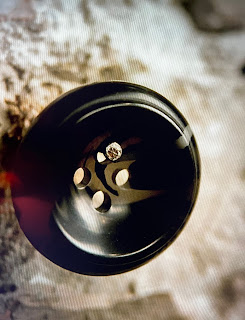
The 2004 interview with John Waters (first included in a Second Sight release) and a new conversation between WFMU's Dave "the Spazz" and Gaylord Fields alone make this a must-own. The detail of the frame above doesn't do the Scope framing or De Luxe color anything approaching justice. When will we have access to equivalent editions of The Lieutenant Wore Skirts or The Disorderly Orderly? •

===


Dragnet

American Ozu?

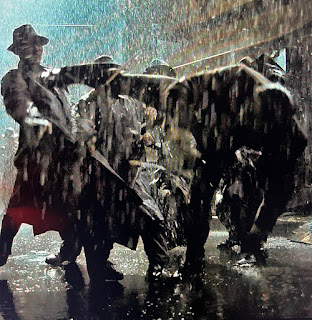
Jack Webb's 1954 feature Dragnet might be the ne plus ultra of the police procedural with its rat-tat-tat voiceover that only begins by slinging down: "Monday, April 25th, 9am." Investigative obsession: nothing can shake Joe Friday from the trail: a relentless, badgering, one can even say fascistic dedication to the cause of Law and Order. His interrogation method — and he's all interrogation, a man-machine deprogrammed of human pleasantry — might be kindly characterized as "pushy," even "Aspergerian." Fast and furious does the scenario pummel out the details of the case, knocking the wind out of the image's Ozu-like objectivity (see the detail of the frame above) and the images' razor-keen découpage. Sound versus image in a duel between the told and the shown. (Did Jack Webb know of Dragnet Girl?) 

(On a_film_by in 2004, Jonathan Rosenbaum pointed out the comparison of Webb to Ozu made by Thom Andersen in Los Angeles Plays Itself, while Richard Modiano wrote: "[A] reason Dragnet was associated with the right was Jack Webb's anti-communism as expressed in the fantasy film he introduced and which was shown in schools. It was called something like "When the Communists Take Over America," and came to be regarded as low camp. Here in Los Angeles during the '50s and '60s Webb was a prominent supporter of conservative causes, for those who know this back story taints the '60s show. Be that as it may, the 1950s Dragnet has some intelligent formal ideas working for it that make it worth viewing again.")

===

Thursday, May 12, 2022

"My Father Told Me My Good Mood Was Artificial"

new lyrics — 

My Father Told Me My Good Mood Was Artificial

I spit on a moth, and knocked it down

Can’t I get some crypto for that

Cut my brows with toenail clippers


Swallow my pride, toasters fly

Face-filter me in fucked sunrise

Dad was always a good thing for me


Now I hit you

I hit you

I hit you

I popped you one


Beginning to grok what I’ve begun


You’re yawning, spit in your mouth

Hit you with a croquet stick

You’re young, cut my brain for six


So six will eat now 

Your lips are balmed and stick

Orange fox bit right palm, molars, abscessed tongue


So I hit it

I hit it

Smashed it till it splashed

Cumin and atom-bomb


Good-weed-grok the moth


Beginning to grok what I’ve begun


===

Sunday, May 08, 2022

Le joli mai

"The First Springtime of Peace..."

Chris Marker and Pierre Lhomme's epic direct-cinema portrait of Paris in May 1962, Le joli mai [The Lovely Month of May, 1963] chronicles the day-to-day lives of disparate city-dwellers in what had turned out to be the immediate aftermath of the Algerian War. As Marker puts it in his narration (recited by Simone Signoret in the English-voiceover version, Yves Montand in the French-voiceover version; Montand sang the song whose title lent its down to Marker and Lhomme's film), Paris might be "the greatest set in the world," after he has already gone on to muse whether "One would like to return to Paris after a long absence, to find out if the same keys open the same doors." He wryly deems May '62 "the first springtime of peace." We might recall Marker's '62 masterpiece La Jetée, which I wrote at length about here, in whose narrative a hydrogen bomb has brought ruin to the city and forced its denizens into subterranean existence. If Le joli mai, though, has a theme, it is the exploration of general happiness — or as we would likely put it these days, an investigation into what makes for a quality of life. In its line of inquiry then, along with its specific era and general technique, Le joli mai is not divergent from Agnès Varda's L'Opéra-Mouffe [1958], Jacques Rivette's Paris nous appartient [1960], or Jean Rouch and Edgar Morin's Chronique d'un été (Paris 1960) [1961].

The film, 2 hours and 23 minutes total, with 20 minutes of deletions excised by Pierre Lhomme at the time of the 2012 restoration and included separately on the 2013 Icarus Films DVD, is divided into two sections, the latter slightly longer than the former. Yves Montand performs the "interlude," "Le joli mai." I can't distinguish much thematic variation between either section of the movie but their titles are evocative enough of the eminently Parisian Surrealist pedigree to warrant their mention: "Part One: Prayer on the Eiffel Tower" (after Giraudoux) and "Part Two: The Return of Fantomas." 

In 1964 remarks that Marker provided following a screening at the Jeune Cinéma following a screening and discussion of the film, on the subject of the interview method used throughout the picture and as reprinted in the Icarus Films booklet and titled "Passionate Objectivity," he said: "....we absolutely do not have the right to reduce [those captured in the film] to what we would like them to be. Otherwise we'd have a demonstrative film; it's very, very easy; we isolate sentences, we put a commentary between them, we emphasize a stumble, a slip of the tongue, whatever, and then we end up making a film where we show that all of France is Gaullist, that all of France is anti-Gaullist, that France is progressive..." Marker continues: "We forbid ourselves from deciding for people, from laying out traps for them .... If there is one thing that's unbearable — on television or the radio for example — it's a trick question. That kind of exorbitant advantage, holding out a mic or a camera, puts others in an inferior position; if they are not afraid, they feel almost flattered to enter this amazing world of film and television — for a little while they would be ready to say anything to make you happy; at worst they are so distraught that they say absolutely anything. .... From this rough footage I was indeed obliged to choose; because there are nevertheless 45 hours of film; my own version would have been six hours, I think it was valid, but I was not followed: there are few people who are willing to enter the theater at six o'clock with the prospect of leaving it at midnight. Yet ultimately, this 2-3/4 hour version ... represents a kind of ordering of the main themes in a direction which seems to me to be a spirited one. .... If when leaving the film the viewer could feel a little bit ... that the only significant problem is a kind of true relationship with others, trying to come to feel what the people around us want, what we ourselves want and to what extent there are things in common that we want, then I think that this film will not have been useless. .... For those who do not continue to live off of that completely formed image they find every day in France-Soir or in the news, each time they think 'Black' that they think 'Algerian' that they think 'Militant,' we need another image to replace that one, which helps them to know that these people exist and what they are really like..."

Chris puts it better than I could. But another touchstone? Mario Ruspoli (collaborator of Marker), several of whose films I subtitled into English for the Metrograph theatrical run and subsequent Kino Lorber Blu-ray release with the help of Florence Dauman of Argos Films. In a January interview published in the March 1997 issue of Positif, no. 433, Antoine Bonfanti, the sound engineer for Le joli mai cited Ruspoli's 1961 Regard sur la folie [A Look at Madness] as influential upon Marker and Lhomme's film. "The questions asked [in Le joli mai] were extraordinary. We began with: 'How does it make you feel to be in peace for the first time in 100 years?' — it was just after the Évian Accords [which after nearly 7-1/2 years of war signaled a cease-fire agreement between France and the provisional Government of the Algerian Republic]. People answered: 'But we only had three wars!' We talked to them about the Riff, colonial wars, but for them those weren't wars. And the other questions had to do with money, communism, happiness, and other things. We went very far with that."

Pierre Lhomme discusses the restoration in a 2013 conversation collated by Jean-Michel Frodon: "...We also needed to establish a 'final cut' which to tell the truth does not exist. The film was released in a rush, in order to comply with the dates scheduled with operators. As soon as it came out, Chris began making cuts. In the version that is distributed today, I have made, per his wishes, some cuts that we had talked about and that he didn't have time to make himself. Besides, The Service des Archives du Film have a restored copy that is the same as the film that was released in 1963, the 'long version,' geared towards historians, researchers, and the curious."

Guest-glimpses include Edgar Morin, Jean Rouch, Anna Karina, Jean-Luc Godard, Jacques Rivette, and Alain Resnais, pictured below.  •



===

Other writings on Chris Marker at Cinemasaparagus:

Sunday in Peking [1956]

Letter from Siberia [1957]

La Jetée [1962]

Le joli mai [The Lovely Month of May, 1963]

Leila Attacks [2007] (posted in 2007, and including a note in the Comments from Chris Marker himself)

===

Tuesday, May 03, 2022

The Choirboys

Are There No Nadirs in "Auteurism"?


In my visions of straw-men I can practically bring into focus what certain film-writers I admire probably think: There's a post-Hawksian quality to Robert Aldrich's 1977 The Choirboys that resituates male camaraderie in the broadly improbable terms of comic relief: a bulwark versus what, for all intents and purposes, amounts to a dramatic stalemate. See The Flight of the Phoenix, Twilight's Last Gleaming, The Choirboys...

Now that that's said, The Choirboys rankles as an hysterically homophobic, racist screed set in a morally corrupt California police department hellbent on exposing "perverts" and littering the streets and apartments with their corpses, under the guise of an institutional critique — which is always the cop-out, if you will. Charles Durning and Burt Young are excellent; fools in the cast include a leering James Woods and an intentionless Randy Quaid. As for the director himself: What is there to ask oneself but, This is the same man who made Kiss Me Deadly?

===

Saturday, April 30, 2022

The Flight of the Phoenix

"The Little Men with the Slide-Rules and Computers Are Going to Inherit the Earth"

+

The Wrong Brothers

+

Shit Burning Man


A Robert Aldrich failure, 1965. The least interesting take on Hitchcock's 1944 wartime masterpiece Lifeboat. Burdened by terrible performances, with the exception of (an admittedly one-note) James Stewart, Dan Duryea (underused), George Kennedy (underused), Peter Finch (underused), and a German named Hardy Krüger. Too many Brits make up the cast, "old chap," in far lesser locomotion than Aldrich's very good UK-set two-minutes-shorter-than-2-hours-22-minutes The Killing of Sister George of 1968, and they do what white Britons (except for The Beatles) always do in movies: nothing (that's a Godard paraphrase) or, rather, emote like pigs. There are some beautiful shots of dune-trudging. (Porcile?) Otherwise you're made to watch a group of sub-Hawksian monotones join together like the males they are and perform some incomprehensible and wildly inauthentic shit to an airplane (chartered by "ArabCo," intended destination Benghazi) in order to let it take flight again, for a distance that finally seems to have been a half-mile: obviously "the Phoenix" is going to fucking fly, as was evident from the first second of the imminent disaster. 

Krüger says to Stewart: "You behave as if stupidity was a virtue." Hence, no Thunder Bay [Anthony Mann, 1953] or The Spirit of St. Louis [Billy Wilder, 1957] — instead, The Flight of the Phoenix.

===

Other writing about Robert Aldrich at Cinemasparagus:


===

The Last Sunset

"Do You Like God?"


The opening doubles Aldrich's double-play in Vera Cruz of 1954: O'Malley (Kirk Douglas) and Stribling (Rock Hudson) ride in successive shots through a mountain pass; as Douglas says later, "This fellow and I are kind of bound up with one another." Indeed: Hudson is a sheriff with a warrant out for Douglas's arrest on account of his killing his brother-in-law. The script by Dalton Trumbo (his second collaboration with Douglas since getting out of Blacklist-jail with Kubrick's 1960 Spartacus) and Aldrich takes a deeper burrow into what we might deem the 'psychological western' than in Aldrich's previous Vera Cruz with different scriptwriters and a different sensibility on the part of the director. Here there are prolonged scenes of dialogue and mutual-moistening, that buck the horse-code: movement / chat / movement / chat. It all takes place under wide-open outdoors. Everything bleeds under the blue Arizona skies: "Women like that [Miss Breckenridge, i.e., Dorothy Malone] ... are worth $1500 apiece, delivered to a Dutchman in Vera Cruz."

Douglas later learns that "Missy"/Melissa (Carol Lynley) with whom he falls in love out of half-spite for Hudson's advances on Malone — Missy is a double of her mother Malone, and 'worth one-fifth of the cattle in the cattle-drive' — is his daughter... according to Malone. 

"God has a special love for drunks, and fools, and children just like you."

Welcome in 1961 to the post-Mann psychological western, in which Rock Hudson / Stribling is portrayed as less intellectual and complicated than cunning Kirk Douglas / O'Malley, whose production company Brynaprod put this movie into motion.

===

Friday, April 29, 2022

Vera Cruz

Some Words from My Sponsor (François Truffaut)

Robert Aldrich's violent 1954 film (the hand-made titles signify washes of blood) was the second western shot by (Harold) Hecht-Lancaster Productions, made possible by the success of their first collaboration earlier in the same year, Apache.

I'll use this space only to suggest you seek out Truffaut's 1975 collection The Films in My Life [Les films de ma vie] for the critic's precise 22-point breakdown in 1955 of Roland Kibbee's and James R. Webb's adaptation of Borden Chase's story. I'll quote a paragraph that follows this plot synopsis:

"Vera Cruz is built on the repetition of themes: two encirclements by the Juaristas; two thefts of the same loot; Cooper saves Lancaster's life and Lancaster Cooper's. I have left out the role of Nina, which is perfect: a) she is caught by a bandit's lasso; b) Cooper frees her by catching the fool with his lasso; c) Nina thanks Cooper with a kiss on the mouth d) during which she steals his wallet; e) as he starts to leave, she offers him an apple; f) he starts to reach for his wallet to pay for it, and g) she tells him "Don't bother; it's free"; h) later, they meet and Cooper scolds her for stealing his wallet. "Have you looked carefully for it?" He finds it in his pocket. It's Nina who brings Cooper to the Juaristas. In the next-to-last scene we see them walking toward each other. We don't see them in the last scene."

Truffaut concludes: "Some of [my colleagues], understanding nothing at all of [Vera Cruz], denounced it as pompous and childish. It was Victor Hugo who asked, "Who are all these children, not one of whom knows how to laugh?""

===

Other writing about Robert Aldrich at Cinemasparagus:


===

Three Women

Not the Altman

Three Women [1924] by Lubitsch is not so very odd — a paramour invests a rich widow's money, then lives for a period off it, high-hog. He lavishes attention on her daughter Jeanne, pronounced the American way presumably since she's also "Jeannie," and since this is America... Porcine post-Berlin fellow whom he owes money to recognizes the subterfuge... and approves as chances are he'll be paid back... The scoundrel-paramour marries the daughter to the chagrin of the mother, and of the daughter's Berkeley sweetheart... Soon afterward he enjoys the fruits of Jeanne's trust-frund and he takes on a harlot'ish lover, Harriet...

Decor you can touch, doors you can open, guns you can shoot. It's a Lubitsch melodramedy.

===

Other writing about Ernst Lubitsch at Cinemasparagus:


===

Thursday, April 07, 2022

LICORICE PIZZA in the Cahiers du cinéma


From the January 2022 issue of the Cahiers du cinéma, no. 783.

===

PALE AND BLUSHING CHEEKS

by Jérôme Momcilovic

translation from the French by Craig Keller


Making use of roads off the beaten path, to say nothing of the birth of a love affair, Licorice Pizza leaves you in a state of gentle, and paradoxical, amazement. Gentle because the gentleness of the film itself, come to fruition in The Master, Inherent Vice, and Phantom Thread, but fully unthreading here, beneath the guise of a light and vintage romance, with a novel and nurturing limpidity — dare we use that cliché of film distributors: we’re happy just to get it out there — light, recognizable. Paradoxical because there’s so much here that is absolutely staggering, from the mastery of a filmmaker assertive as never before of his actions, or of the disarming simplicity that’s become his horizon-point. It’s also the fact that, as in his three preceding films, Licorice Pizza takes off without having totally pierced the aura of mystery that has by now surrounded, in varying degrees, the films of Paul Thomas Anderson.


A dense mystery, permeating like a fog or a state of intoxication (The Master, Inherent Vice), or even a tiny mystery perceived beneath the form of a light perplexity at the film’s conclusion — what did we just see? have we already seen it? (Phantom Thread, Licorice Pizza): the feeling in each case is that the characters are living a life perfectly independent of the spectator. It has, rather, been regulated by the grand American cinema to feel exceedingly present despite the film’s intentions, incubated by them, pampered by the spectacle — entertainment: “mission to interview,” Daney said. Charming without playing the smooth-talker (difficult without being so, what with the similar sets, costumes, music-cues), Licorice Pizza panders to no-one, no single eye: it takes to the roads that sing its song, and its slightly communal grace owes much to this impression that it is animated by nothing other than its own pleasure in watching what it watches, and in showing what it shows.


What does it show with so much joy and sweetness? Above all two superb characters: a boy and a girl all at once golden and banal, brought together by an amorous urge complicated by a slight, but decisive, age difference. Gary (Cooper Hoffman) is still a high-school student, so the few years separating him from Alana (Alana Haim) provide slim chance for advances that he eagerly throws her way as soon as he meets her and the film starts, in the courtyard of the high-school where Alana has come for the day to assist with school photos. If the urge is called to triumph all the same, it’s that in reality each of them is feeling the other one out with their ages serving as an offbeat sticking-point. Gary’s sixteen years keep him in school, and are often betrayed by things like his chubby figure and light-hearted mood, but a singular spirit of initiative makes of him an already very accomplished man, leading in his spare time a double career as actor and seasoned entrepreneur. On the other hand, Alana breaks down the doors of adult life, held back less by immaturity than by a precocious tendency toward disenchantment.


Here we find an insistent motif in PTA’s cinema, that in which the fiction of the couple apparently plays a classic role of reconciliation between opposites, in order to organize between the two parties a perpetual transfer of traits and positions, an elastic rapport with unforeseeable combinations, reaching for a meeting-point that’s less than safe. Sometimes the point of harmony ends by being found (the complicit pact that closes Phantom Thread); sometimes the film opts for regret and sentences the two parties to their tragic fate as asymptotes, each one drifting out on their own sea, their own astrological trajectory (The Master, Inherent Vice). Licorice Pizza belongs to the first category: it’s there from the first scenes, from Gary becoming smitten with Alana, her long skinny legs and her sardonic grin.


Here then is a second point in common with the most recent Tarantino: Licorice Pizza, like Once Upon a Time… in Hollywood, believes in destiny. The first point in common is obviously the era, the set-design, which, around Hollywood in the early ‘70s (1969 for Tarantino, 1973 for PTA), was the environment of the early childhood of the filmmakers. Like Tarantino’s film, Licorice Pizza at moments floats in a soft and exhilarating irreality. This isn’t just a matter of the colors, suitable to Los Angeles and the ‘70s. In this respect, Inherent Vice markedly pushed the trip farther, but that was a ghost movie, whereas Gary and Alana are vibrantly alive — singularly alive. It’s also a matter of the strange population that resides within this movie-world neither entirely on the side of reality nor entirely on that of fiction: relatively unknown actors, workers in the shadow of the movie industry, that the two films gaze upon with the same amused tenderness.


But let’s come back to destiny. Once Upon a Time… in Hollywood created an unflinching and very moving interpretation of destiny. Since destiny, the film seems to say, is by definition that which must arrive, all there is to do is wait. Await, in the company of the characters, the rendez-vous that fate has fixed for them; wander about in the time of the film; rove about in the era and the setting; kill time to watch. Licorice Pizza leaves a neighboring but sensibly different impression. Its incessant divagations (stories of waterbeds, pinball machines, trucks hurtling through the Hollywood Hills to the point of no return and in reverse: all things pleading in the name of the film for an uncontrolled moment) seem so many unexpected detours, screwball bifurcations, but we can’t really say, once the end-credits roll, if they’ll have mattered much given the dénouement of the story. The films directed by PTA since The Master all have the same atmosphere of cubist odyssey: one comes away with the impression of having taken a grand voyage, but the itinerary remains opaque. The hand of destiny has been displaced, henceforth unable to be found on the surface instead allowing his œuvre to take seed at the subterranean level of the narrative. It suffices here to pay attention to the lyrics of “July Tree,” Nina Simone’s sublime song that accompanies Gary and Alana’s meeting: seeds of love have been planted, it’s enough to wait two seasons. It’s a touch more time than is required, in fact, for the story of Licorice Pizza to reach its goal.


This strategy of diversion has several advantages. In placing his films under the sign of Uranus, “the planet of big surprises” (Inherent Vice) offers of destiny a representation otherwise more inventive than that of his first films (Boogie Nights, Magnolia, Punch-Drunk Love) in which, by way of confusion between fate and cinema, and with the excuse of being young and virtuosic, he vainly exhausts himself on a puppet theater. To allow destiny to do its subterranean work, lodged beneath the skin of the narrative, which deals on the surface with waterbeds and pinball machines, is for PTA’s cinema to treat itself to two things. First, a powerful emotional vector — this is what the immediate perception indicates: these four most recent films have jaw-dropping endings. Second, and foremost: a liberated period to watch its characters, and so then its actors.


PTA believes that Licorice Pizza owes almost everything to the faces of its two young actors, Alana Haim and Cooper Hoffman. The pleasure that he took in filming them is evident. And we’d be brushing over the essential matter if we didn’t emphasize that these two faces are new to the cinema, and the pleasure of filming them comes across in being the first one to have done it. Just like the twists and turns of the scenario are sewn together from anecdotes told by PTA’s entourage, this daring casting (two young unknowns with imperfect faces, while in the background of the scene such actors as Sean Penn and Bradley Cooper content themselves as apparitions) was already at hand: Alana Haim performs in a band founded with her two sisters who also play roles in the film; as for Cooper Hoffman, he’s the son of Philip Seymour Hoffman — PTA saw him grow up alongside his father, who died in 2014, having shot five films with him.


With this radical and radiant choice, combined with the fact that PTA, having remained faithful to celluloid film, is here as in Phantom Thread as his own director of photography, Licorice Pizza goes all the way to the end of a direction that is slowly digging itself further inside his œuvre. The most recent films can be seen as affirming themselves in a very distinct taste for faces, and adjacent to them, an interest for pale skin in which emotion betrays itself when the blood hits the cheeks — already, when PTA lands on such decorated actors as Philip Seymour Hoffman, Julianne Moore, Amy Adams… With the diaphanous visage of Vicky Krieps, Phantom Thread made a veritable theorem out of this preference when it came to the mise-en-scène, from which Licorice Pizza inherited an eloquent precaution: no longer that this would-be unknown face would go flush from the first appearance of the characters; those of Alana Haim and Cooper Hoffman sported no make-up on set. It’s because there’s something to see here that cosmetics would have masked: not so much the skin itself as a trembling emotion in arrays of pink just under the surface. It’s here that the seeds of love grow in silence, here that resides the trembling beauty of Licorice Pizza: beneath the rosy cheeks of Cooper Hoffman, who has his father’s pale skin.


Thursday, March 24, 2022

"Rolex Laxative"


These are the lyrics I penned for the opening track on an album I'm writing. More to come.

===

Rolex Laxative


Kern County time moves a wholly different pace

Cosines alone can’t chart residents’ space

Airport Café and the Five Finger Pub

Exercise their lottery rights, and there blow the rub

Do a double-take at the Brewery as I believe that’s the guy

Who’s the multi-instrumentalist of Hundred Digits of Pi


A teachable moment

The Great Emancipator

I had a dream as an omen

On her graphing calculator

Kernites exercise their watery rights


Could’ve sworn I dialed 3-1-1 a long time ago

One plank creaks while the others don’t

McNally’s Outpost and the Pizza Barn

A “Steal Your Face” sticker spins sticky yarn

Charting her course in seconds, cosecants

Garbage bag fragrance and indifferent sequence


A teachable moment

One hand dangling free

Drawstrings are drawn open

To chuck that disused tambourine

Kernites exercise their watery rights


Behold the spirits milked from the net-entangled dairy-deer

Believe it or not, you’ll never find a ride-share here

Buy fish-market jackal-meat then perfume it with make-up

Even dumb-bell Lake Isabella dogs can sense a break-up

It’s all true about me in California with an Arizona tag

On the way I re-rigged Peter Frampton’s tubes for colostomy bags


No bombs will ever fall on Kern

Will ever fall on Kern

Never-ever

Never-ever


Writing well is the best revenge

Is the best revenge

For what you want

For what you want


Evidence of my single hike proves my proactivity

Flexing my tendons and choking on reflexivity

The neighbor’s lights at night lend dimension to the space

Rolex laxative

Rolex laxative


The radiance

The radiance


===

Wednesday, January 26, 2022

Vitalina Varela - A Text by Yannick Haenel

VITALINA VARELA

by Yannick Haenel

2022


(translated from the French by Craig Keller)


My friends, before it leaves the big screen, rush to see Pedro Costa’s Vitalina Varela: this is very important. We can all agree: the cinema in its near totality has turned to shit, is soulless, has sold out to that hysterical movie-trailer factory which only produces images of our tolerance for junk. But a few filmmakers find unscathed images: images that, through their political dignity, through their poetic rectitude, cut themselves off from tawdry hell; among these filmmakers, there is Pedro Costa.


Vitalina Varela deboards a plane barefoot. A chorus of cleaning-women inform her that she’s arriving too late; her husband has been buried three days prior. “Go back home,” the chorus intones. But Vitalina Varela was waiting for more than twenty years in Cape Verde for her husband, emigrated to Portugal, to send her a plane ticket. She’s here, and she’s here to stay; she’ll reside in the dead man’s house; will enter the unveiling of this darkness that grips Cova da Moura, that gerry-rigged poverty-stricken neighborhood on the outskirts of Lisbon, which seems a necropolis. 


The roof is rotting, the door won’t close all the way, men walk inside without knocking. Vitalina Varela gets dressed at nighttime; the whites of her eyes tear through the darkness: anger is a form of resistance.


Between life and death there opens a gap where pain speaks. This is where it all takes place: cinema is possible here, like poetry. A knife comes closer to our throats at every instant: we are expendable; the women and men escaping execution are devoted. After Buchenwald and Dachau, Robert Antelme had this to say: “We can no longer tolerate being touched; we feel ourselves to be sacred.” Vitalina, since her period of mourning and her revolt, is sacred — separate: she speaks to the dead, to her dead one. 


Those women and men who have been sacrificed by Western horror, the victims of colonial dump-off, like the Black workers from Cape Verde such as Vitalina, live at the heart of this chasm in which light and dark tear themselves apart. Pedro Costa films from this darkness that is the state of sacrificed light; and all the splendor of the film comes from the arrivals of light that deliver themselves from the dark background. When the heart thinks, darkness vanishes into thin air. A different house is constructed in the blue pleasure of the mountains. Repairing the roofing is an act of love.


A sick and trembling priest, whose church has been abandoned, tells Vitalina that the world has broken since Judas’s kiss. The cheek he kissed remains obscure: “It’s from these shadows that we’ve been made,” he says. But the nocturnal density enveloping Vitalina’s body in her house lends her an aura: she belongs to the light of the other cheek: that which has not been touched by Judas. It’s the radiant cheek: its light is the political force that gives back life to the sacrificed. •


===

Sunday, January 02, 2022

Ancestral Teacher of a Generation (aka The Grandmaster)

Stand and Deliver

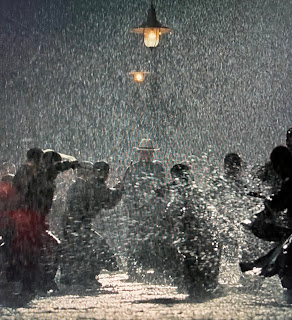
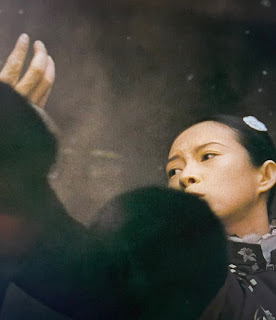
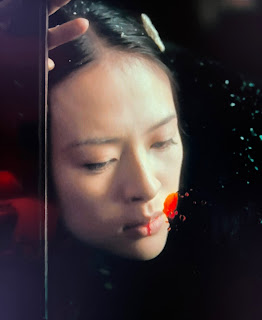
Horizontal; vertical: Those are the two characters that make up the word "kung fu," as we are told by Ip Man (Tony Leung), the real life martial arts master of the wing chun style and eventual mentor to Bruce Lee. Ancestral Teacher of a Generation [Yi dai song shi, also known as The Grandmaster (its English title appears at the end of the credits), 2013] exists in three different cuts of various lengths and unique content: a Hong Kong cut, an American cut (presided over by Harvey Weinstein, with Wong's supposed sign-off), and the domestic Chinese cut, which is the longest and, according to those who've studied all three versions, the richest. As Wong mastered the wuxia with Ashes of Time, so too in The Grandmaster does he present the most exciting kung-fu-movie-cum-dynastic-epic in years. But whereas Ashes of Time made jaw-dropping use of a lysergic color palette, The Grandmaster is all blacks, beiges, silvers, and whites — the falling rain 'steels' the image in this story that spans the 1930s to the '50s. Lessons:

"A bird that has no perch to sit on." — We've heard this phrase before, in Days of Being Wild

"I have two hands, but wing chun has eight kicks."

"A tiger never quits the mountain."

"As life as in chess, a move once made stays on the board."


===

The Books I Read in 2021


My Brooklyn Writer Friend

by Greg Gerke

2015


Let Me Tell You What I Mean

by Joan Didion

2021 (1968-2000)


Small Fry

by Lisa Brennan-Jobs

2018


Holzfällen

[Timber-Felling]

by Thomas Bernhard

(translated by David McLintock)

1984


Nicholas Nickleby

by Charles Dickens

1839


Balloon Pop Outlaw Black

by Patricia Lockwood

2012


No One Is Talking About This

by Patricia Lockwood

2021


Once Upon a Time in Hollywood

by Quentin Tarantino

2021


See What I See [Expanded Edition]

by Greg Gerke

2021


Harmonium [Second Edition]

by Wallace Stevens

1923/1931


Harlem Shuffle

by Colson Whitehead

2021


A Swim in a Pond in the Rain: In Which Four Russians Give a Master Class on Writing, Reading, and Life

by George Saunders

2021


Images en parole

[Images in Words]

by Anne-Marie Miéville

2002


Caderno de rodagem: ‘Vitalina Varela’

[Shooting Notebook: ‘Vitalina Varela’]

by Pedro Costa, et al

2021


Fear Stalks the Land!: A Commonplace Book

by Thom Yorke and Stanley Donwood

2021


The Haitian Chronicles

by Douglas Turner Ward

2020


“A Christmas Carol” and Other Christmas Writings

by Charles Dickens

1835-1854


The Old Curiosity Shop

by Charles Dickens

1841


===