Tuesday, January 24, 2023

The Rite

The Ritual of Art, After All

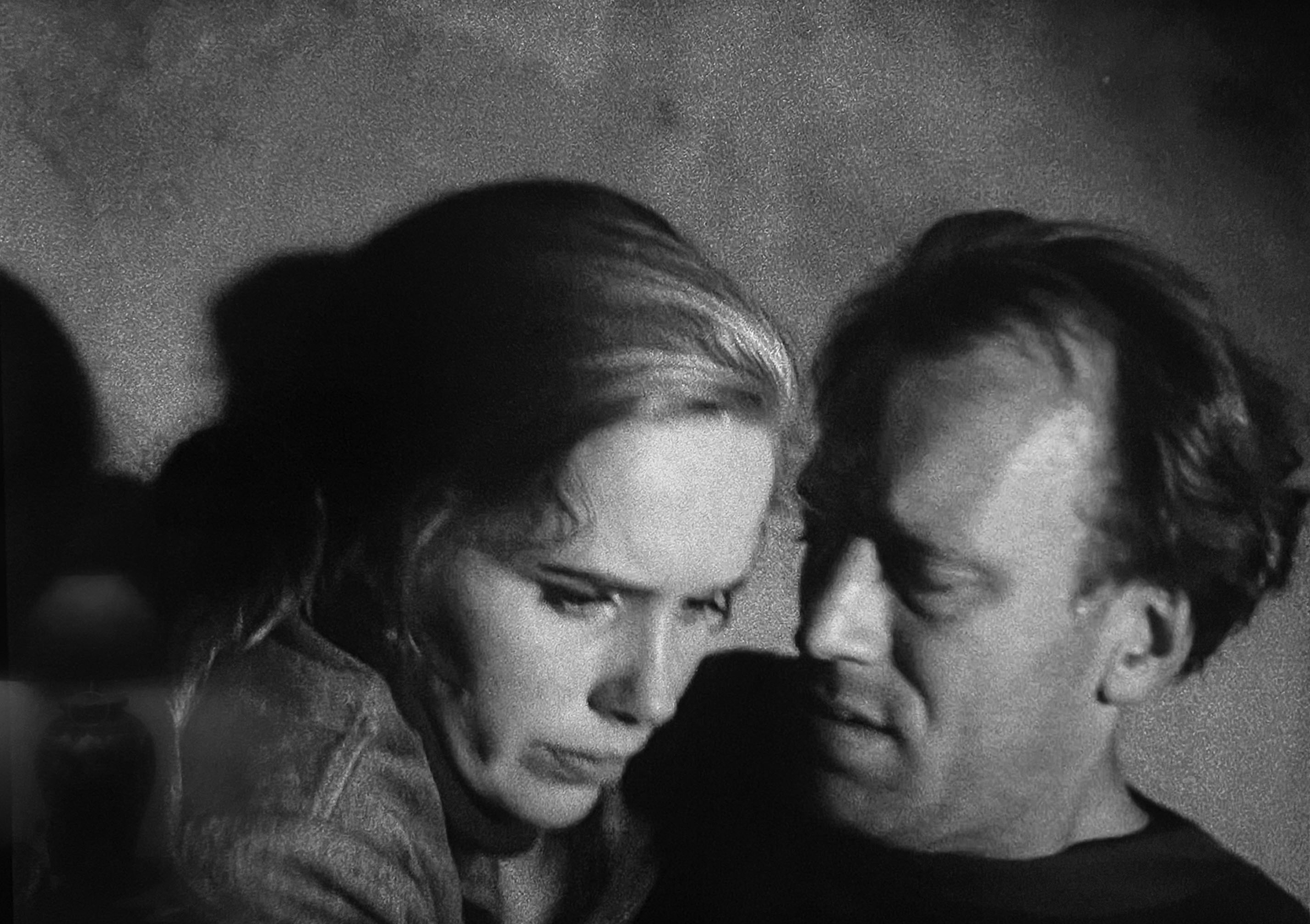
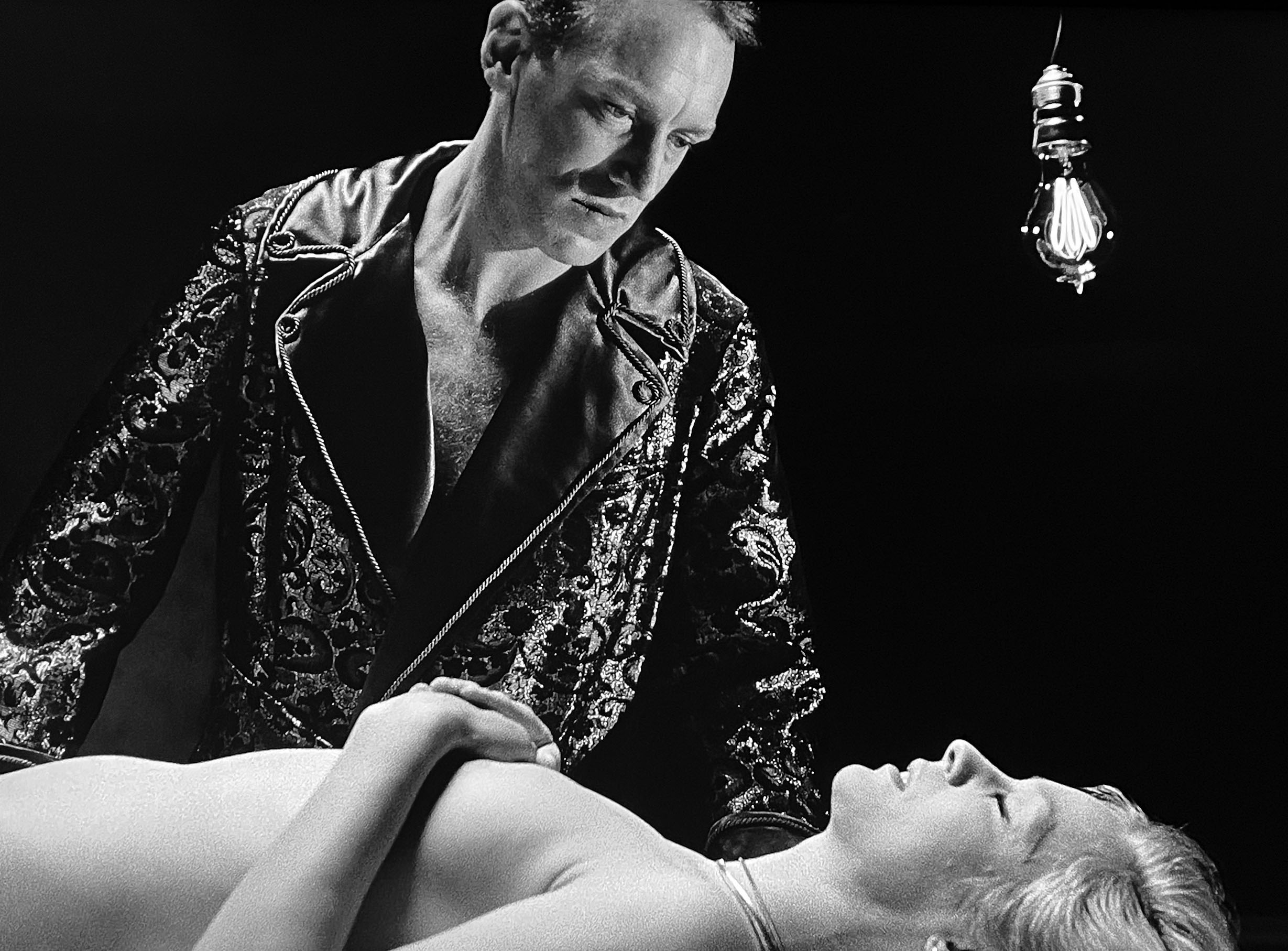
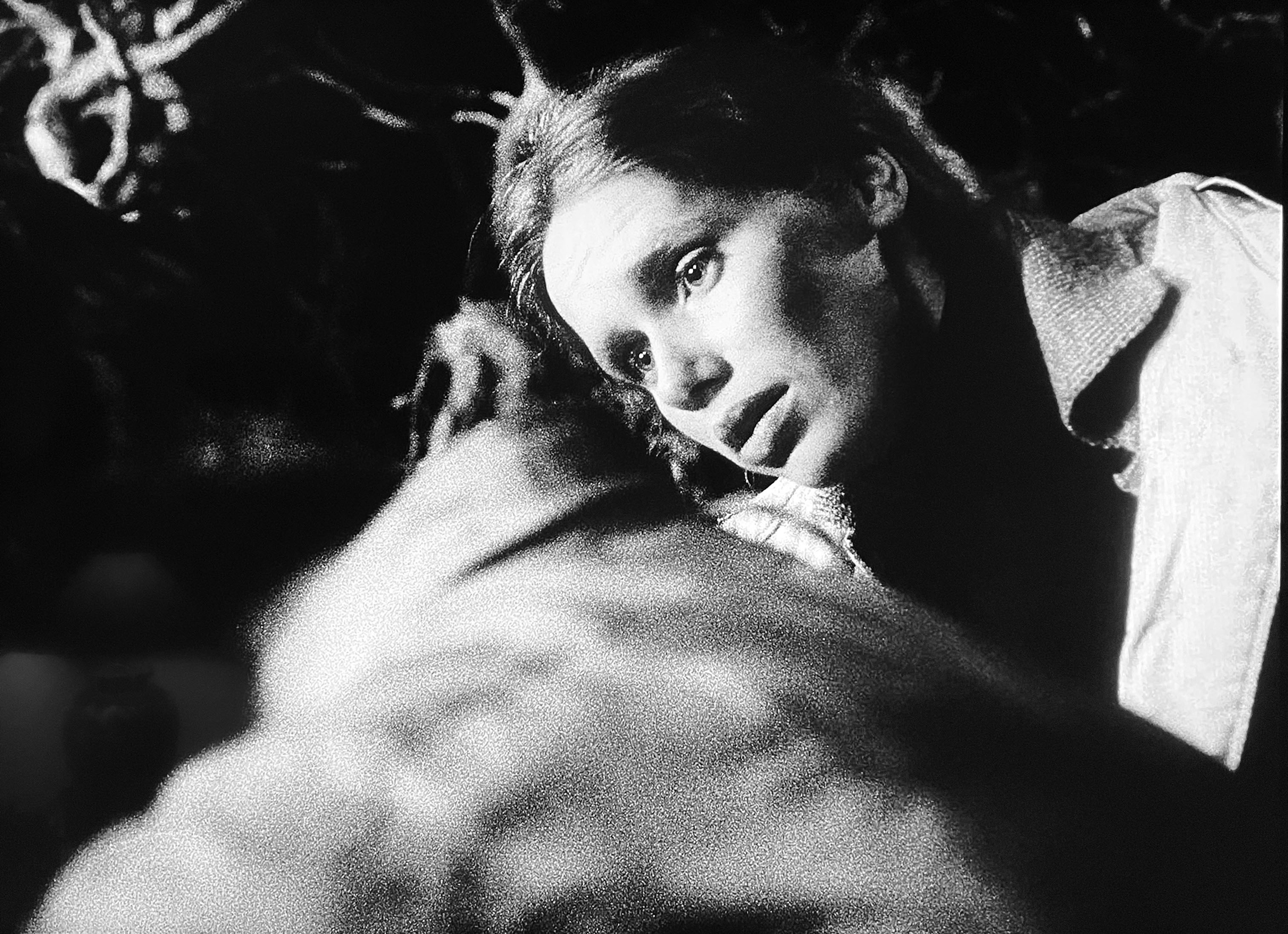
Within the coruscations of Bergman's "art film" trilogy (The Hour of the Wolf, Shame), The Rite [Riten, 1969] is the most 'pop'. It's got a 1 hour 10 minute runtime, it's neatly divided up into a number of chapters or scenes that are discrete and straightforward, and what in a pop song would be a hook is here communicated by an endless array of close-ups on the faces among some of the most beautiful ever filmed. Bergman made this film for Swedish TV before it ran theatrically around the world; it's somehow has never recovered from its 'second-tier' reputation, while being perhaps one of his greatest films. Sven Nykvist shot it, but both the close-ups and some of the lighting (most noticeably in the bar scene) lend itself to the small broadcasting tube-screen of living rooms in 1969. 

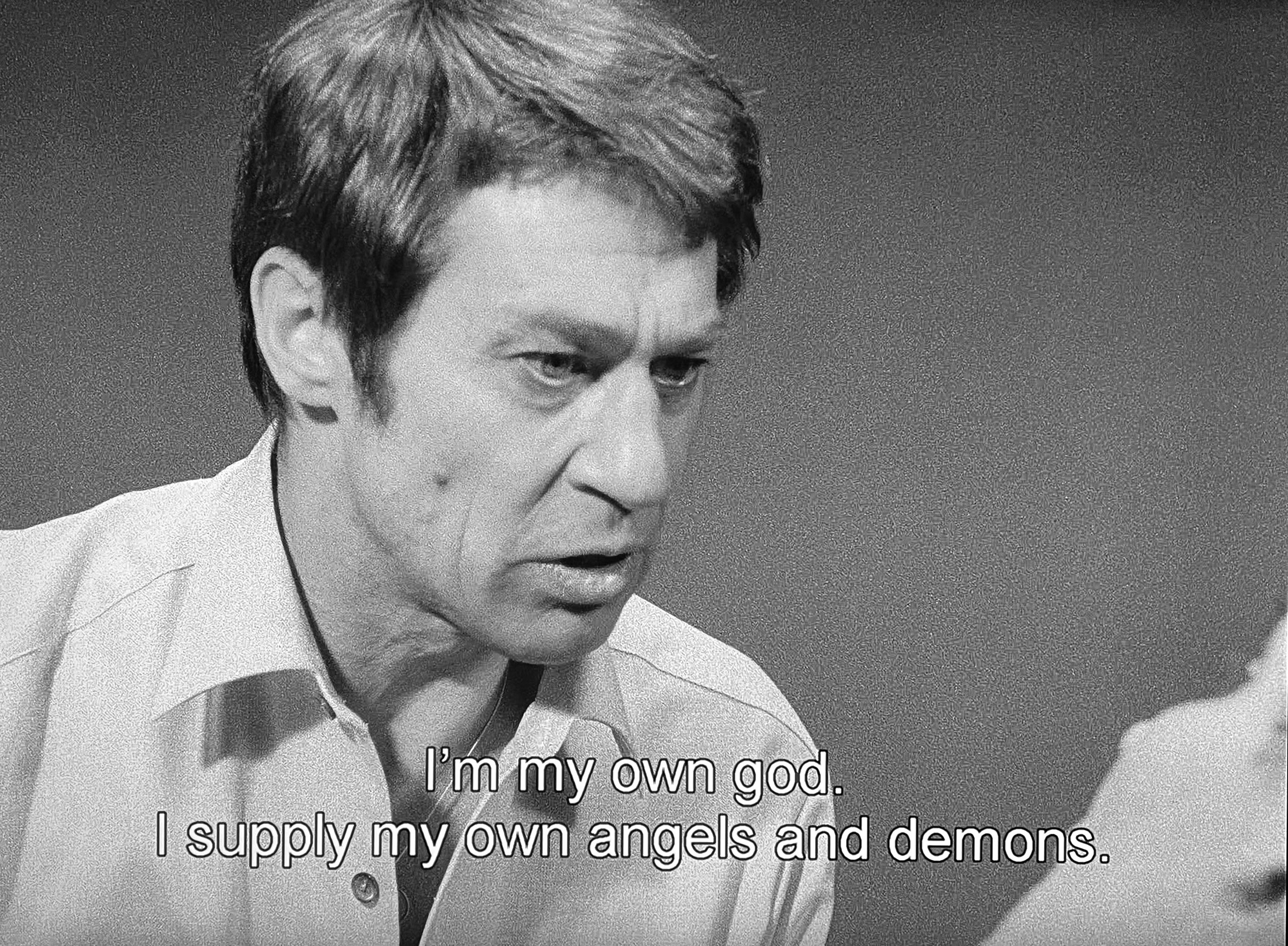
Within this aquarium, then, swim three Swiss citizens: Hans (Gunnar Björnstrand), Thea (Ingrid Thulin), and Sebastian (Anders Ek). They are under examination by a doctor-cum-judge (Abrahamson, played by Erik Hell) for their latest stage production which under nominal and unstated pretenses has been deemed transgressive. Theirs is the crime of being artists. Artists' crimes among the troupe have brought them to an interesting place of ménage-à-trois arrangement. 

"One day the stream will choke on islands."

Bergman, who would be horrified to read his film called a descendant of Une femme mariée. 

The punishment for artists is having been, or is being, misunderstood. We stand beneath stripped branches, the snow falls as deemed by the wind. •




Saturday, January 14, 2023

Poemquotes 23: From Baudelaire's "Spleen and Ideal"

(my translations)

 
XLI.
Tout entière
[41. Completely, Wholly Her]

The Demon, in my lofty chamber,
Came to see me this morning,
And, trying to catch me in the act,
Says to me: "I should like to know,

Among all the beautiful things
Her enchantment of which is made,
Among the black or pink objects
That make up her charming body,

Which is the sweetest." — O my soul!
You replied to the Abhorred One:
"Since in Her everything is dittany,
Nothing can be preferred.

When everything ravishes me, I am unaware
Whether something is seducing me.
She dazzles like the Sunrise
And consoles like the Night;

And the harmony is too exquisite,
Which governs all her beautiful body,
For impotent analysis
While noting the numerous chords.

O mystical metamorphosis
Of all my senses melted into one!
Her breath makes music,
As her voice makes perfume!" •

===

XLII.

What will you say tonight, poor solitary soul,
What will you say, my heart, heart once withered,
To the very-beautiful, to the very-good, to the very-dear,
Whose divine gaze has suddenly reflourished you?

We shall set our pride in singing her praises:
Nothing is worth the sweetness of her authority;
Her spiritual flesh has the scent of the Angels,
And her eye clothes us in a light-habit.

Whether it be in the night and in solitude,
Whether it be in the street and in the multitude,
Her airborne ghost dances like a torch.

Sometimes it speaks and says: "I am beautiful, and I command
That for the love of me you love only the Beautiful;
I am the guardian Angel, the Muse, and the Madonna." •

===

XLIII.
Le flambeau vivant
[43. The Living Torch]

They walk before me, these Eyes full of lights,
That a très-savant Angel has doubtlessly magnetized;
They walk, these divine brothers who are my brothers,
Shaking into my eyes their diamond fires.

Saving me from any snare and from any serious sin,
They guide my steps in the route of the Beautiful;
They are my servitors and I am their slave;
All my being obeys this living torch.

Charming Eyes, you sparkle from some mystical clarity
That candles have burning in full daylight; the sun
Reddens, but does not extinguish their fantastical flame;

They celebrate Death, you sing of Awakening;
You're walking, singing the awakening of my soul,
Stars whose flame no sun can annul! •

===

XLIV.
Réversibilité
[44. Reversibility]

Angel full of gaiety, do you know anguish,
Shame, regrets, moans, troubles,
And the vague terrors of those frightful nights
That grip the heart like a paper that one crumples?
Angel full of gaiety, do you know anguish?

Angel full of goodness, do you know hatred,
Fists clenched in the shadow and tears of gall,
When Revenge beats its eternal call,
And makes itself captain of our faculties?
Angel full of goodness, do you know hatred?

Angel full of health, do you know the Fevers,
Who, along the great walls of the greyish charity-ward,
Like exiles, go off dragging their feet,
Seeking the rare sunlight and muttering lips?
Angel full of health, do you know the Fevers?

Angel full of beauty, do you know wrinkles,
And the fear of growing old, and that hideous torment
Of reading the secret horror of devotion
Within eyes in which for ages our avid eyes drink,
Angel full of beauty, do you know wrinkles?

Angel full of happiness, of joy and lights,
Dying David would have sought health
In the emanations of your enchanted body;
But I only implore of you, angel, your prayers,
Angel full of happiness, of joy and lights! •

===

XLV.
Confession

One time, one only, amiable and gentle woman,
To my arm your polished arm
Leaned (on the tenebrous background of my soul
This memory is not faded);

It was late; just like a new medallion 
The full moon displayed itself,
And the solemnity of the night, like a river,
Streamed over sleeping Paris.

And along the houses, beneath the portes cochères,
Cats furtively passed by,
Ears cocked, or indeed, like dear shades,
Slowly accompanied us.

Suddenly, in the middle of a free-and-easy intimacy
Spawned by the pale light,
From you, rich and  sonorous instrument in which only resonates
The radiant gaiety,

From you, bright and joyous like a fanfare
In the glittering morning,
A plaintive note, a bizarre note
Escaped, all tottering-like

Like a sickly, horrible, somber, unclean little girl
Of whom whose family is ashamed,
And who would have her hidden away from everyone for a longtime,
In a cellar kept in secret.

Poor angel, she was singing, your harsh note:
"That nothing down here is certain,
And that always, with some care as to how it's face is painted up,
Betrays human selfishness;

That it's a hard profession, all this being a beautiful woman,
And that it's the banal work
Of the mad and cold dancer swooning
Within a mechanical smile;

That to build on hearts is a crazy thing;
That everything breaks, love and beauty,
Till what Oblivion chucks them in his basket
To give them over to Eternity!"

I have often recalled that enchanted moon,
That silence and that languor,
And that horrible whispered confidence
In the confessional of the heart. •

===

Shame

What's a Determinist? / The Thick of It

The usual Bergman credit typeface, Optima, has been replaced with a serif-font; the 'regular world' has been scrambled and broken. As Michael Sragow writes in his essay in the Criterion Ingmar Bergman's Cinema volume, "Shame [Skammen, 1968]'s white opening credits unspool on a black screen as machine guns and artillery fire punctuate polyglot scraps of newsreels and broadcasts. This audio mélange is the opposite of white noise. It signals that the war is closing in on [the weakling] Jan (Max von Sydow) and Eva (Liv Ullmann). We feel their alienation in our bones. The movie picks up on the couple shortly before warplanes firebomb the forest, paratroopers drop from the air, and shock troops swarm in from the sea. Eva is already beginning to lose patience with Jan's pettiness and escapist nostalgia." There is a clipped manner of tongue and language while Jan eats his breakfast ravenously, as happens in European films.

Shame represents a semi-sequel to The Hour of the Wolf; politically, goes further than Persona in its explicit anti-war sentiment, in which the dark night of the soul spills its obscurity over into the physical realm: planes flying overhead executing bombing maneuvers, a paratrooper caught hanging from a tree, no longer anything but a corpse. All this brings to mind the shadow-invasion of The Silence with its convoy of tanks en route to where and wherefore? Shame resembles an oozing puddle whose boundaries expand to cover significant ground: the picture is a portrait of all wars, invasions, civil strife; of secret, cold wars. Look at the names of the principals: don't Jan and Eva Rosenberg bring to mind Julius and Ethel Rosenberg? Doesn't Jacobi (Gunnar Björnstrand) strike the near-identical physiognomy of William Faulkner? A shattered twentieth century. Two ex-violinists, the Rosenbergs (fiddling away in the world-as-prison-camp), of whom Bergman in an interview opined, "They understand nothing." Two sides of the manuscript: no politics but the freedom to live and be stupid. The musical 'score' (Bergman insisted that there be no 'score' per se) is like a banging on windowpanes from the outside.

The final words of the film are pronounced by weary Eva. "...something someone said — but I've forgotten what it is." •


===

Tuesday, January 10, 2023

The Hour of the Wolf

When the Hour Is Nigh

Ingmar Bergman's 1968 The Hour of the Wolf [Vargtimmen] begins under the opening credits with the sound of film-set carpentry, and snatches of the director's voice providing suggestions to the crew, and thus links to the 'reveal' of the production in the closing moments of Persona. A certain logic links the two films, both the most prominently 'vampiric' works in Bergman's œuvre; one person sucks the life out of another. In the case of Persona, it's a single woman split into two, gorging off herself in the midst of breakdown. With The Hour of the Wolf it's an artist Johan Berg (Max von Sydow) who's gone emotionally silent toward and increasingly passive-aggressive against his wife Alma (Liv Ullmann).

A pre-credits pair of title cards explain that Johan has disappeared and has left his diary behind, and it is 'this' which the film is based upon. Alma takes a seat at a picnic table in the opening moments and relates to-camera the strange story of his absence. "I've given you the diary." She has a baby due in the month (of which Johan was aware). Despite Johan's being a renowned artist, Alma tells that every now and then she takes a job at a market on the mainland to make ends meet.

We flash back now to the main action of the film, some months prior to the prologue, to the couple's arrival on the island (Fårö? — not literally in this film, but in the two that bookend it) — so many Bergmans since The Seventh Seal kick off with an arrival on a shore, a primordial invocation, a tabula rasa. Once the couple is settled in after unloading their items from the mainland and has made a home of the cottage, Johan and Alma share a quiet interlude in the back of the property. He sketches Alma. This might be Johan's final happy moment. Ullmann lets bare her shoulders, the light is perfect, she looks like a pre-Raphaelite subject.

Moments later in film-time Johan counts down the minutes from his pocket-watch to share with Alma what duration (and by extension, the pain of successive moments) in the world means: terror in silent time. Shortly after, Alma will be visited by a ghost who tells her that within Johan's satchel stashed beneath the bedframe she'll find his diary ("dagbok" emblazoned in black marker across the cover in Bergman's handwriting)... Baron von Merkens (Erland Josephson, in his first significant Bergman role) invites Johan and Alma to a dinner at his castle... But Alma's found Johan's diary and it goes...

Interlude: Excerpt from a 1968 Swedish television interview with Ingmar Bergman, conducted by Nils Petter Sundgren, as cited in the book that accompanies Criterion's Ingmar Bergman's Cinema Blu-ray boxset: "When a tooth aches, you are constantly touching it with your tongue. If you have got a wound, you are constantly aware of it. It's also a want of having contact. I experience my pictures very much as a want of contact. I seek other people to talk to through my pictures, and there is, perhaps, some kind of idea that if I talk and tell them about my wounds, tensions, and problems, other people might recognize something in that, something of their own, and it may then have a relieving effect on other people. [...] I think it's terribly important that art exposes humiliation, that art shows how human beings humiliate one another, because humiliation is one of the most ghastly companions of humanity, and our whole system, our whole social system, is based to an enormous extent on humiliations."

Writes the Sydney critic Sarinah Masukor, "His murder of the boy, for example, could be read as a vision or as a memory, an indeterminacy effected by the image itself."

The diary goes...

1. A woman (Ingrid Thulin) approached Johan on the shore. She stands from kneeling and comes close to him — the first zoom-in in Bergman? This is Veronika (Veronica?) Vogler.

2. Chased by a critic-sycophant, Heerbrand (Ulf Johansson), school counselor, Johan smacks him to the ground.

Johan has time only for his painting. He can't even review Alma's careful accounting, of which she's clearly proud, when she discusses the bills and household economy. 

At the dinner-party, Baron von Merkens relates how he once purchased a painting from a favorite artist, then invited him over to witness the prank of his work having been hung upside-down.

Did Alma have a stage career? Watch her face during the revelation of the (live) puppet-theater ("the Living Theater"?). (cf. Persona). The audience looks on like the members of the same public a few years later in Bergman's brilliant The Magic Flute.

Late night / early morning with an outdoor walk. cf. Fellini's La dolce vita and Antonioni's La notte.

Now appears the intertitle "VARGTIMMEN" or "THE HOUR OF THE WOLF". As though it weren't before...

A few people make a big deal that Johan's break results from his 3. snakebite scenario while fishing, when the angry half-dressed lad shot in high-contrast leaps onto his neck and bites like a viper before Johan smashes him against the rock and then with a rock to the skull, multiple times. Real or not real? As Alma (and bear in mind the other Vogler are names repeated from Persona) pronounces in the final words of the film: "Sometimes you don't know up from down, and you go completely..." •


===