Saturday, August 19, 2023

The Image Notebook: Preview of FILM ANNONCE DU FILM QUI N'EXISTERA PAS "DRÔLES DE GUERRES" by Jean-Luc Godard

Emotion / Passion

The following appeared in the Cahiers du Cinéma no. 798, May 2023; cover story: "Cannes: Alternating Currents" — the Aragno text was conducted by Marcos Uzal via telephone on April 26th, 2023. Translations by Craig Keller.

===

Undoubtedly, one of the events of the year will be the discovery of the final film that Jean-Luc Godard finished completely and approved of just before his death. A text by Nicole Brenez and remarks by Fabrice Aragno, two of his faithful collaborators (with Jean-Paul Battaggia) return to the genesis and conception of this hand-made film.

FABRICE ARAGNO

"We had to stop, notably because of the pandemic confinement, and postpone the shooting of the film known as Drôles de guerres [Phony Wars], which we didn't end up making. As usual, Jean-Luc made a paper pamphlet for this film, with collages, photos, hand-written texts, in a very artisanal manner. In the same manner, he also made a pamphlet of the "trailer" that explicates Drôles de guerres — some forty-odd pages in A5 format on card stock. At the beginning of last year, he had the idea of filming all the pages, attaching Post-It notes to indicate the number of seconds each shot should last. I put it all in a timeline and it made up a film, each shot of which was one page. Then he made a document with colored markers, indicating the placements of the sound to the nearest second. "From such-and-such minute to such-and-such second, place such-and-such excerpt from Notre musique, or such-and-such piece of music, or such-and-such end of an interview that we did together to talk about the film to be made," etc. The indications were all provided graphically, and I manually put together the film at my home, but Jean-Luc was so precise that the result corresponded exactly to what he had been thinking, without his needing to place his hand on the cutting. It was completely finished and approved by him."

NICOLE BRENEZ

The first of March 2022, in a weary but firm voice full of joy, Jean-Luc Godard declares to Fabrice Aragno and Jean-Paul Battaggia, who record him on the subject of Film annonce du film "Drôles de guerres": "I don't know what you thought of it when I told you it was one of my best films; what I like is that it's very slow, very silent at times, and then there's something else — so it's perfection." For those who have become accustomed to the permanent self-criticism thanks to which Godard's work evolves, the surprise is considerable. After Sisyphus, imagine Godard happy? Jean-Luc thought about the duration of each shot on the physical model of the few seconds dedicated by visitors to an art museum to the perception of each painting, with, on the horizon, the extreme figure of Reger, this character of Thomas Bernhard who, for thirty years, just sat every two days before Man with a White Beard (according to 1985's Old Masters). Thus the slowness, the kinetic version of a contemporary residue of contemplative experience, yes; the silence, the blank page, yes. But then, what would this “something else” consist of that allows access to an even ironic perfection? Initial hypotheses: beings engaged in their cause until death; the irruption of a moving shot in the age-old history of immobile images, of which sometimes a film revives the miraculous character; a dense web of open or broken relationships between words, images, and sounds; the last bursts of a devouring research on the negative; much suffering, torture, lost battles, flouted ideals, on a piece of paper that bears the name of a weapon ("Canon"); various phases of the work, sometimes very old, laid bare and joined; shadow mouths, falls, dizziness; the pathway to a text where one can read: "If she is dead, don't forget. If she is dead, a simple announcement. A simple announcement." (Charles Plisnier, Faux passeports, 1937).

A PROMENADE: PHOTOGRAPHS BY FABRICE ARAGNO, AND HIS NOTE

These photos taken in January 2022 go back from the time of the realization of this film. They're sketches done with black-and-white cinema 35mm, with scraps of reels mounted on spools in order to stick them into a film camera [cf. À bout de souffle from 1960. —CK], which was cheaper than unwinding 120 meters inside of a camera. It was just to see the quality, the grain, the contrasts of this film-stock. As I didn't know what to take pictures of, one I took my device along when I went to see Jean-Luc. These sketches were for Drôles de guerres, for which we were equipped with 35mm, 16mm, and Super 8 cameras. I continued on with the sketches for Drôles de guerres, but Jean-Luc was already started on the film trailer. •

===

Thursday, August 17, 2023

Have a Nice Life

Breakdowns


Have a Nice Life, the 2021 feature by the up-and-coming filmmaker Prashanth Kamalakanthan, is one of those films you find programmed in the sidebar of a regional festival, but which one will go back to a few years from its premiere for the sake of the completist viewing of an intriguing new director's œuvre. 

Have a Nice Life combines the template of the indie road-trip, the buddies-on-the-run movie, and the portrayal of a culture clash: Jyothi (Jagathi Kamalakanthan, the filmmaker's real-life mother, in an amateur but natural performance) and Sophie (Lucy Kaminsky, a natural performer whose talents are anything but amateur, and who bears a passing resemblance to Eleanore Pienta) criss-cross after the latter is ejected from her grandfather's guest-house, and the former becomes estranged from her husband while he takes up with another woman in Montreal. Somewhere in the middle (in the middle of North Carolina), Jyothi and Sophie set out to catch up with Jyothi's husband — and along the way a rifle murder occurs when a 19th-century firearm goes off while pointed at a clerk's chest. Jyothi, a fledgling American citizen, thus becomes wrapped up in Sophie's purple/green/neon manic fantasy-land — did this murder even occur? The irony of the title Have a Nice Life springs from the South Asian tradition of frequently arranged unhappy marriages, and the Hindu belief in the transmigration of souls — Jyothi and Sophie, their first-names chiming, might even bring to mind the Vice Versa scenario. 'Far' from being a journey from NC to Quebec, the pair instead circle around the state in a continuous whirlpool of paranoia. Which brings to mind three beautiful moments, for Kamalakanthan does not relegate himself only to script and color-correction: (1) Jyothi swishing her foot distractedly in a rain puddle while on the phone with her mother;  (2) Jyothi's "welcome" mat sitting on the inside of her apartment's threshold. 

—(BONUS) Sophie in a pawn shop disguised in a blonde wig, unloading a copy of the early Masters of Cinema Series UK DVD edition of Toshio Matsumoto's 1969 cult drag classic Funeral Parade of Roses (released before I came on board to work on production of the series), with the store-clerk remarking: "I met him at the airport once — Matsumoto. Same plane. They called him up to security — they wanded him!" 

Identity static, stark, and infinite. "We gotta stay on the small roads now..." You never have to stay on the small roads: but when you finally hit them, you know still broader pathways await. •


===


Friday, August 11, 2023

Excerpts from Cahiers du cinéma - Hors-série Nº 1 - Cinéastes - François Truffaut

"Truffaut mode d'emploi" - Part One

(all translations by Craig Keller, from the French)
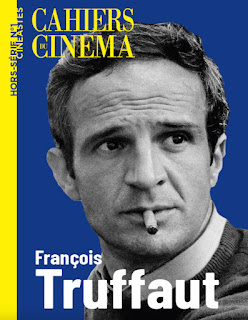
As of April 2023, Cahiers du cinéma have launched a new series of thick special issues (outside the regular subscription series) called "Cinéastes" ("Filmmakers"), editions of which will be released roughly twice a year, and which consist of a wide-ranging investigation of a director's biography and complete body of work. This inaugural issue, edited by Thierry Jousse and Marcos Uzal, is devoted to François Truffaut, and takes as its blueprint the essential special issue of the Cahiers known as Le roman de François Truffaut [The Novel of François Truffaut] published shortly after the director-critic's death by a brain tumor in 1984. Both editions supplement one another; the earlier might be a bit longer; the later work itself numbers 133 pages, and includes a few reprints from Le roman. All future numbers of "Cinéastes" will consist of a mixture of texts from Cahiers issues past, and articles newly commissioned for the series. In their editorial "Truffaut mode d'emploi" ["Truffaut User's Manual" or "A Guide to Truffaut"], Jousse and Uzal write: "For this first issue, the name of Truffaut sprang to mind very quickly. First off, because the filmmaker exercised, from the outset, his critical gifts in the Cahiers and because he was, by and far, linked to the history of this revue. But another thing, and maybe most especially, because his films continue to touch and to stimulate us, to this day, almost forty years after his too-early passing. Imperfect, varied, playful, and sometimes tragic, his œuvre has nothing of 'the monument' about it. On the contrary, when one revisits his films, one is almost always struck by their impurity, their inventiveness, and their paradoxical aspect." An accurate summation of the work of this master, who is not only among my favorite filmmakers in all cinema, but also probably my single favorite film critic, with Serge Daney (who appears in this issue) a close second. Without further ado, some translated excerpts from this landmark compilation. If you can read French (and even if you don't), I urge you to pick up a copy at Amazon.fr, FNAC, or the Cahiers online boutique itself; you can order it here.

===

Truffaut's List of the Ten Best American Talkies, Cahiers nº 150-151, December 1963

(in chronological order)

Scarface [Howard Hawks, 1932]

You Only Live Once [Fritz Lang, 1937]

The Magnificent Ambersons [Orson Welles, 1942]

Notorious [Alfred Hitchcock, 1946]

The Saga of Anatahan [Josef von Sternberg, 1953/1958]

Johnny Guitar [Nicholas Ray, 1954]

Rear Window [Alfred Hitchcock, 1954]

A King in New York [Charles Chaplin, 1957/1973]

North by Northwest [Alfred Hitchcock, 1959]

===

Truffaut's List of the Best French Films Since the Liberation, Cahiers nº 161-162, January 1965

(in chronological order)

Les enfants du paradis [The Children of Paradise / The Children of the Cheap-Seats] [Marcel Carné, 1945]

La Poison [Sacha Guitry, 1951]

Le carrosse d'or [The Golden Coach] [Jean Renoir, 1953]

Nuit et brouillard [Night and Fog] [Alain Resnais, 1955]

Lola Montès [Max Ophüls, 1955]

À bout de souffle [Breathless] [Jean-Luc Godard, 1960]

L'enclos [Enclosure] [Armand Gatti, 1961]

Le testament d'Orphée, ou Ne me demandez pas pourquoi [The Testament of Orpheus, or: Don't Ask Me Why] [Jean Cocteau, 1959]

Procès de Jeanne d'Arc [Trial of Jeanne of Arc] [Robert Bresson, 1962]

Les parapluies de Cherbourg [The Umbrellas of Cherbourg] [Jacques Demy, 1964]

===

from

Ali Baba and the "Politique des Auteurs"

On Ali Baba et les quarante voleurs [Ali Baba and the Forty Thieves] by Jacques Becker

by François Truffaut, 1955

Circumstances required that I see Ali Baba twice in a little theater with no ambiance before finally watching it again on a much more adequate screen, one night on Christmas Eve in the midst of five thousand spectators at the Gaumont-Palace among whom — as Renoir put it — only three people were able to "get it." Is it necessary to clarify that I lined up straightaway alongside those three select suspects, besides the existence of the other two?

On the first viewing, Ali Baba deceived me; on the second bored me; on the third enraptured and delighted me. There's no doubt that I'll be seeing it again, but I well know that, having victoriously passed the perilous cape of the number 3, every film takes its place in my private, shut-up museum. (Parenthetically speaking, if every cinephile had seen Key Largo, The Treasure of the Sierra Madre, and The African Queen three times, there would be many less "Hustonians.")

It's not that in rewatching Ali Baba one understands or discovers more things — as happens for example with The Golden Coach, Gentlemen Prefer Blondes, or Casque d'or, but following the example of musicals (Singin' in the Rain, An American in Paris, etc.) Becker's latest film succeeds in being known for being appreciated. You have to go beyond the stage of surprise, you have to be familiar with the structure of the film so that the initial feeling of imbalance has vanished. [...]

Had Ali Baba been a failure I would have defended it anyway by virtue of the politique des auteurs that my colleagues in criticism and myself practice. All based on the beautiful phrase of Giraudoux's: "There are no œuvres; there are only authors," — it consists of denying the axiom, dear to our forefathers, according to which films are like mayonnaises: those that fail or those that succeed.

From one instance to another, our forefathers came to speak, without losing any of their gravity, of the sterilizing old age, even the spoilage, of Abel Gance, Fritz Lang, Hitchcock, Hawks, Rossellini, and even Jean Renoir in his Hollywood period.

Despite its tortuous scenario by ten or twelve individuals, ten or twelve people too many with the exception of Becker, Ali Baba is the film of an author, an auteur who has achieved exceptional mastery: un auteur de films. And so the technical success of Ali Baba confirms the legitimacy of our policy, the politique des auteurs. •

===

from

Loving Fritz Lang

On The Big Heat by Fritz Lang

by François Truffaut, 1954

On the eve of writing an article that he'd like to be both general and precise, exhaustive and researched, the movie critic begins to envy of his literary confrère the privilege of the library where heavy volumes of complete bodies of work, like so much tapestry, can be consulted and quoted at will. [A telling contrast between the periods of 1954 and 2023; although my understanding is that Truffaut was an early adopter of seeing movies on videocassette in the early '80s. —CK]

It's actually rare that all a filmmaker's movies be in screening-circulation at the same time; it's the reason for which I appreciate the value of seeing the appearance, in December 1953, of a new Fritz Lang: The Big Heat, that the neighborhood theaters show Chuck-A-Luck [Rancho Notorious] and Cloak and Dagger, whereas the Parnasse rescreens Scarlet Street, and the Cinémathèque gives us one night after the next, the final German film: Das Testament des Dr. Mabuse (subtitled in Danish) and the first American one: Fury (subtitled in Flemish).

Moral solitude, man conducting alone a fight against a semi-hostile, semi-indifferent universe — such is Lang's favorite theme. This theme... it's not even the titles that attest to his consistency: M [M le maudit, or M the Cursed in France. —CK], Fury, You Only Live Once, Man Hunt, etc. [...]

"The Big Heat. Neither bad, nor all that good. Fritz Lang is no longer Fritz Lang. We've known it already for a few years now. There's no more trace of symbolism in the present-day works made by the director of Metropolis. And of expressionism, still less." These few lines by Louis Chauvet are a prime example of the synthesis of sophisms that it be becomes vital to clear away. In revisiting Fritz Lang's œuvre, one is struck of what there is of the Hollywood style is his German films (Spione, Metropolis, Das Testament des Dr. Mabuse) and of what he willed to conserve from the German style in his American work (sets, certain lighting effects, a taste for perspectives, sharp angles, — in the present instance, Gloria Grahame's mask, etc.). One easily understands what might have been some irritation in the departure of the best of our European filmmakers for Hollywood, and the puerile temptation to see, in terms of exile, the clearest disappearance of their genius, — but rather isn't there chauvinism to be found in this account if our critics would prefer to adopt the opposite bias (since the grace of knowing how to watch seems to them forever refused) and declare the the best of American production comes as a result of European inspiration (Hitchcock, Lang, Preminger, Renoir, etc.)?

Another legend would have it that the American metteur en scène be a "crafty handyman" who "saves what he can" in the way of the "alarming" subjects "imposed" on him. In this case, isn't it strange that all of Fritz Lang's American films, although 'signed' by different screenwriters and shot for the benefit of the most diverse firms, very tangibly tell the same story? Doesn't this suggest that Fritz Lang might indeed be a genuine auteur of films and that if his themes, his stories, 'borrow' in order to come to us, the banal appearance of a serial thriller, a war film, or a western, one must perhaps see there the sign of the great integrity of a cinema that doesn't test the necessity of adorning itself with enticing labels? What follows is one certainty: to make something in the way of cinema, you have to pretend, or, if one prefers this slogan: to speak with the producer, disguise is de rigueur. And yet, it's true to the extent that one disguising themselves as their opposite, one won't be shocked to hear of my preference for filmmakers who imitate insignificance...

One must love Fritz Lang, salute the arrival of each of his films, to rush to them, to return to them often and impatiently await the next one (this will be, this time around, The Blue Gardenia). •

===

from

Journey to Italy by Roberto Rossellini

by François Truffaut, 1955
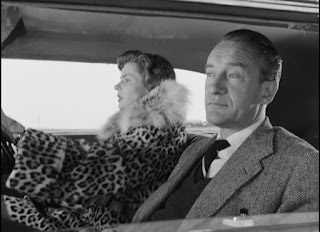

Here: novelty everywhere. Form, content, subject, technique, fabulism, acting, cinematography, score. Journey to Italy is the first film to take for its subject only emotion and its variations. Whence the completely musical construction of the work arranged around themes of life and of death. On one hand, in Naples, some pregnant women regard Katherine [Ingrid Bergman] with envy, and on the other hand: ashes, dust, bones. Naples is the city of miracles, the city in which — according to Roberto Rossellini — more than elsewhere there emerges the feeling of eternal life; therefore we're not surprised by a death so benevolent, smiling, and... present. Journey to Italy is the film of a state of a soul, of a difficulty in being (together) that in the end becomes, by the force of things, the dignity of purely and simply being. The Katherine of Journey to Italy  is situated, morally and socially, mid-road between the sinner touched by grace, Karin, of Stromboli, and Irène of Europe '51, who attained holiness without having aspired to it. [...]

The admirable cinematography of Enzo Serafin, the score by Renzo Rossellini, take part in this novelty, this audacity. Journey to Italy might seem less uncanny that La strada; I find it more original and more audacious; sentimentality and literature having no part it in the proceedings. As with Francesco, giullaire di Dio, like Europe '51, like Jeanne au bûcher, Journey to Italy resembles nothing nothing of what's been done in cinema. Roberto Rossellini's œuvre is "outside," "on the margins"; each one of the films that compose this body of work is a total effort to liberate the screen from bygone servitude. Since Roma città aperta, Rossellini has not ceased going forward; at present he is the most personal and the newest of film-auteurs. •

===

from

On Pure Cinema

On Assassins et voleurs [Killers and Thieves] by Sacha Guitry

by François Truffaut, 1957


The term "masterpiece" is all the more hackneyed as it [still] remains to be defined. Everyone will agree with this.

Assassins et voleurs places itself under the sign of immorality. First off, immorality of a cynical scenario and a text glorifying adultery, thievery, injustice, and murder. Immorality especially of a double financial and artistic success, defying all the rules dictated by good sense and experience; paradoxical success and nearly scandalous success as we see it.

Assassins et voleurs, contrary to any of the films we defend in the Cahiers, is stripped of all aesthetic ambitio; there's not even the slightest indication of professional conscience; a boat scene, supposedly taking place on the open sea, was obviously shot on the sand — the hotel elevator doesn't rise any more than the boat moves forward, the same set being used several times; the long scene between Poiret and Serrault, divided into ten or twelve sections was obviously filmed in one afternoon with two cameras, and so crudely that by listening carefully one can hear the buses passing in front of the studio-hangar, and the technicians on the neighboring set chat happily about their work-break. [...]

This curious film, whose luck is maybe to not have been "edited" by Mary Seton, proves that success doesn't necessarily depend on misunderstandings and that a funny and insolent work without too much vulgarity, interpreted by worthy actors who are not stars and who direct themselves, filmed without a metteur en scène, a work thrifty to the point of destitution, sloppy to the point of provocation, is welcome in a production that gets bogged down by shyness, cowardice, delusions of grandeur, snobbism, and systematic distrust. •

===

All Alone

by Jean-Luc Godard, 1984


...A film is something that goes... from one's self... comes and goes... from one's self... when he wrote... threw his writing... outside himself... against a certain tendency of the French cinema... François reproached them for not having gone from themselves... to make cinema... an entire cinema... before making films... to leave their home... like the true spectator... every admission into a theater is an exit of the spectator from their own home...

...François started out making cinema with his hand... ink stains... paving-stones in the sea... he didn't hesitate to cast upon others his first stone... I don't know if he continued... one can't do everything... to take on the sins of others before one's own... he did everything everything all alone... everything giving the opposite appearance... so he's dead from it... a film is never made alone... in solitude... yes... often... the white page and the white screen... everyone knows it as such [c'est connu comme le loup blanc]... but wolves [les loups] precisely... or the killers of which Henri Langlois speaks... who smile at you...

...We knew that a film was made alone... but we were four... so it took us a long time to admit it to one another... then certain ones recanted... the screen was our examining magistrate...

...There was Diderot... Baudelaire... Élie Faure... Malraux... then François... there was never another art critic... François was French... he's dead from it... the cinema being international first of all... he smuggled it out of his skin [de sa peau]... on the sly [en douce]... without Uncle Jean [Cocteau] around to help him traverse the mirror... his only passport, books... do you want some books, well here they are... too much information... it goes to the brain... one goes to see Father Alfred so he clears your name... again, a book... the two remained forbidden, speechless [interdits]... etymologically between the real and the imaginary... we will certainly meet them again... •

===


Saturday, July 08, 2023

Jean-Pierre Gorin in 2023: Two Times

The following pieces appeared in the Cahiers du cinéma this early-spring and early-summer respectively. I've translated them into English below. They can be read there in their original French versions here and here at the Cahiers website. Strongly recommend nabbing a subscription if you can.

===

Gorin: Useful Idioglossia

by Charlotte Garson

March 10th, 2023

It's already close to twenty years ago — a generation — that Entrevues invited Jean-Pierre Gorin to Belfort. Cinéma du Réel's program "Le monde, autre" ["The World: Other"] will allow one to submit themselves to a ritual viewing that should be required in any cinephile society worthy of that name: in Poto and Cabengo [1979], Routine Pleasures [1986], and My Crasy L1fe! [1992], all the commonplaces of documentary in point of question ("a point of distance, "dispositif") are rubbed down by the relaxed posture of a singular "I" that stages its own excess, not to say its change of course from the usual.

In Vladimir et Rosa [1971], the groupe Dziga-Vertov film also being presented at the Réel, the combined voices of Godard and Gorin produce an agit-prop in stereo. Subsequently, the two offered to Gorin's American films a life-saving alterity. The twins in Poto and Cabengo, astonishing America because they invented a language with two speakers, form a closed couple only in appearance: the shrinks detect a leader (Gracie, called Poto by her sister), and their strange gift turns out to be deceptive. Attracted by this wonder, Gorin records a deflation of this linguistic mystery, but he profitably gleans the details of a family's daily life. Thinking he could better examine the idioglossia (this is the technical term) of the little girls by extracting them from their family environment, Gorin proves incapable of keeping them within the frame, especially when he takes them to the library — a Borgesian sequence in which the two linguistic curiosities go live. Gorin masters the tragicomic arc of setbacks, the perfect documentary filmmaker being the one who arrives a little too late, at the moment when the windfall of 'the live' vanishes  — in this case when the twins agree "better and better each day with the real world," and abandon their pidgin-speak.

My Crasy L1fe!, an incursion into the West Side gang of Californian Samoans, eschews the same acceptance of a leveling off of the subject: dodging the group's mistrust ("Fuck this National Geographic bullshit!") through one of its members who asks others questions, Gorin takes refuge in… the voice of the car computer of a sheriff who knows the families closely and who is followed to Hawaii. In Honolulu, some vacationing gangsters drop their manly poses; My Crasy L1fe! enters a state of vacation, of childhood (it opened with children's games), and the ultra-violence of the continent seems, seen from the island, completely fictional.

OFF THE RAILS

The jargon of model-train enthusiasts that Gorin filmed more than ten years earlier in Routine Pleasures is as much idioglossia as Poto and Cabengo and the West-Siders. It is enough to see emerging from a trap door, in the middle of a model landscape, one of these retirees concentrated on their work (the film is dedicated to Chuck Jones and Gustave Flaubert, no doubt for the Bouvard and Pécuchet side of the trainspotters) to understand that the exiled Frenchman found there a miniature slice of Americana. But under the leadership of Manny Farber, the mentor whom Gorin will film in his studio throughout the film, he tracks down his own complacency: the ex-marxist-leninist sees clearly that through these Tuesday evening railway workers he is looking for the vestiges of the American working class, while identifying as a filmmaker with these "mad about true detail." The visits to the painter and critic are the welcome reverse shot of the routine pleasures in which Gorin, too quickly adopted by the club, risks winding up. And the “termite” whispered to him, quoting Proust in the face of his French disciple: “We are all memories of a lost time, but they are not your memories, and they are not your past." •

===

Gorin: Handiwork / Ladies' Works

by Charlotte Garson

June 14th, 2023 / conducted March 30th, 2023

this text is the long version of an initial publication in Cahiers du cinéma, no. 799, June 2023

Specially in Paris to present his three films as well as a carte-blanche at Cinéma du Réel at the end of March, Jean-Pierre Gorin, living in San Diego since 1975, brings news to Cahiers as one writes a postcard. From the margins of “this rat hole” that is Southern California, a casual discussion on a decidedly termite art. 

GARSON: Since you emigrated to the United States in 1975, teaching cinema has been your main activity. How did it change your conception of cinema?

GORIN: When I arrived, I had to eat, and thanks to Tom Luddy [see Cahiers no. 797], I met Manny Farber, an important painter and critic who got me into UCSD. He was also a writer with an extraordinary language, a good Virgil for understanding the country, since he covered the whole century. The university's visual arts department was primarily an art school, not a film school. There were people like the poet and critic David Antin, Allan Kaprow [the inventor of the word and the concept of happening within Fluxus at the end of the 1950s —Garson's note], and in their wake, the idea that life was more interesting than art, and that the boundary between the two had to be as porous as possible. In a language that I was only beginning to master, I was trying to teach something beyond cinema: what it was like to be American according to what we saw in films, from Thomas Ince and Ford to Capra or the Maysles brothers. Manny and I would call out to each other, he would come to my classes and we would start talking, it flew over the heads of the blondes, but they were surprised by the liveliness. I was doing a history of cinema starting with a contemporary film, and in the same three-hour class, I ended up in 1900 – from Mysterious Object at Noon to Griffith.

GARSON: In Routine Pleasures, you go back and forth to Farber, as if in search of a lost secret of mise-en-scène.

GORIN: Manny was interested in both Hawks and Ford and fringe, esoteric productions. He had written on Michael Snow, Ernie Gehr... I had not yet read his articles collected in Negative Space; we were talking about painting, which was a way of talking about cinema. In his career, he moved away from large abstract paintings to return to the figurative: on the canvas, flat, he placed small objects or figurines, and he approached them from different angles, hence a polyphony, paths between them. That was the trigger for Poto and Cabengo and Routine Pleasures: an essayist cinema, where in the end, the subject remained alive and where I moved on to something else. The subject matter was really what matters to the subject! What interests me is the moment when I can no longer manage it, when reality is stronger than me. The documentary, usually, starts from a mass of information to arrive at a point of elucidation. Me, I take a needle hole, I sneak in, and I explode. There is always excess, and a happy defeat. In Manny Farber's founding text, on white elephant art versus "termite art," the only thing I question is the "cons": in fact, every film oscillates between the two. "The highest power of fiction appears only when it becomes documentary," said Fritz Lang. I would add: and vice versa.

GARSON: In Poto and Cabengo, your "joyful defeat" is that the little twins who converse in an unknown pidgin have not invented a real language.

GORIN: I wanted to call this film Everybody Talks Funny, because there is also me and my accent, and their German mother and her accent, their grandmother... Then with Manny we considered Two Spoke Together, in homage to Ford. This first film corresponds to my arrival in the United States, to the confrontation with another language, which has become my mother. During my carte-blanche at Cinéma du Réel, I showed En rachâchant [Making Up for Things, 1982] by the Straubs and I Was Born, But... by Ozu, for childhood defined as an uncontrollable gesture, while the adult pounds on the table. Routine Pleasures wonders what exile is: when do we manage to be inside? The guys I film, model train enthusiasts, finally place me in the landscape when they put the little car that is a miniature of my DS on their circuit. A voodoo gesture! On the other hand, I went to the Brumes de Hawks festival, because the guys who play with the little train, it's the collective as playful enjoyment, which connects a whole section of American cinema of the 1930s: a group of guys making a gig. My Crasy L1fe! shows how immersion makes it possible to understand a language that the natives themselves cannot understand: that of gangsters. I chose to put it in resonance with The Musketeers of Pig Alley by Griffith. I don't film the mafia: the Samoan gangs don't want to make a profit, they do small things, and if there are deaths, it's because the police are more armed than them, otherwise they would have had the revolution a long time ago. When there are riots, why do gangs ransack supermarkets? To barter food, but also, because if you're caught by the police with drug money, you're put away for a lot longer, so the gangs liquidate the money in the supermarkets at fifty cents for the dollar. Supermarkets, for them, are usurious banks, which they hate.

GARSON: By describing this political underpinning of the film, you reconnect with the duo you formed with Godard between 1967 and 1973, whereas since then you seem reluctant to talk about this period.

GORIN: At the end of the 1960s, Godard was stuck, he could no longer film, and he found in me this crazy dog that allowed him to free himself. We met through Yvonne Baby, film critic at Le Monde, where, constantly refused entry to the École Normale Supérieure and having relations with Althusser and others, I wrote for three years on literature and culture. Jean-Luc was doing La chinoise. Baby told him, “I know a Chinese man,”and it was me. I told him about his films. When we made our first film together, I told him that we hadn't written anything when we were shooting in four days. He replied, "We're going to write the script tonight!". He takes me to the St. Germain drugstore, to the bookstore. “Keep an eye out." I see him tearing pages at random, then he says "your turn." We cut and we mark at the top: HIM and HER, and we give that to the actors... What people don't want to understand is that Jean-Luc, essentially, is a rhetorician from the 15th century; whether that rhetoric is Maoist or otherwise, it doesn't matter. After my departure, his films lie in the wake of what we did together, like how mine, modestly, are permutations of our common work: a system where we see all the sedimentary layers that create a situation. It's already in 2 or 3 Things I Know About Her, the first film he called me to ask me to see, fresh out of the lab, with Made in U.S.A. We watched them all night.

GARSON: So the break-up was, above all, geographical, circumstantial?

GORIN: No, it went down because I got tired of making films in which the filmmaker had the missionary position: “Look, it’s great, I fuck my subject!" The sexism of cinema lies not only in its representation of women, but in the act of directing, dominating in that it claims to reveal the subject to itself. I came out of it expressing myself in a language that I did not master. I realized that I could create a filmic structure where the complexity came from an alternation between idea and emotion. This is what the essay is all about: ideas which become emotions, which become ideas again, which again become..., etc. With Jean-Luc, when we act together at this point, producing so much, at some point, we can't take it anymore. Naïvely, in my enthusiastic youth, I found that one of the places where the cinema was blocked was in auteurism. So I said: “Let’s try to return to a collective practice of cinema." Which didn't really work, since in fact the Dziga Vertov Group, there were two people...

GARSON: One Poto and one Cabengo.

GORIN: Yes! I hadn't taken measure of the weight of Jean-Luc, who intervened massively in society: without him, modern advertisements would not exist, Benetton, the use of paint as it is. His authorial position is apparently made up of a denial by the author: "In my films, even 'Pass me the salt' is a quotation," but one only has to look at his insane credits, with his voice-over which names the participants, the unrecognized, but which eradicates them at the same time since we only remember the voice. So I left the "landscape" by leaving France. I liked to tell stories, I did not have this anti-narrative puritanism which characterizes part of the cinema of the 1960s. We also see in Poto and Cabengo that I was fed up with people throwing stones at me: it is the film of someone who wants young girls to take it to their mothers and tell them that I am a boy of great sensitivity... Jean-Luc told me, "Do a fictional version after twenty years, when you kidnapped them and live with them!" Because to leave at the end is to abandon them. I'm the bastard of the movie. Narratively, it was like a short story from Chandler: I'm the detective, I quickly solve the case, and I find myself around more complicated moral issues, and in the end it's impossible to continue: I was the savior who was going to bail them out of this environment.

GARSON: You've taught a lot since 1992, but have you been shooting anything?

GORIN: Yes, Messiaen's St. Francis of Assissi, an opera directed by Peter Sellars. For a few years, I've been knocking on doors, but getting funding for a sketch is difficult: everyone wants to know where it's going. I produced unidentified visual objects [a pun on "OVNIs" in French, "UFOs" or now "UAPs" in English —ed.], contrary to the macho posture of documentaries: when you think of what Werner Herzog would do with the twins of Poto and Cabengo... The diktat is to take risks, à la Apocalypse Now. For them, I made ladies' works [des ouvrages de dames]! I wanted to revisit Tocqueville, to do De la démocratie en Amérique, part 2. I thought we could be in San Diego, on the margins, to restart the machine.

GARSON: Did you look for money in France, at the beginning of your life in the United States?

GORIN: The filmmakers of the New Wave and the like, producing others wasn't their thing. They had to create a person, a myth: Chris Marker, the man who does not allow himself to be photographed; Jean-Luc, the rebellious child of the bourgeoisie; and Varda, so solid that she could resist the atomic irradiation, turned into a grandmother of jams. Branding involved, by necessity, limited generosity. The only worker-priest was Straub. These filmmakers were artisans, not producers. Jean-Luc Godard, raving about Routines Pleasures, told me: "I'm going to write about it," but then he added: "Your film is so good that I have to learn to write again."

GARSON: That's brilliant! [laughs]

GORIN: Yes, these geniuses, we don't ask them to be Florence Nightingale. The only thing that annoys me is that people talk to me about this period as if I were still 20 years old. I'm 80. I film a little; I'm working on a dialogue of animals where I would do all the voices and where I would talk about art, politics, sex. It's in the notes. But from time to time, I will film the animals. There is an amazing zoo in San Diego. •

===


Monday, June 12, 2023

In Memoria: Michael Snow. Christine Laurent. Paul Vecchiali. Andy Rourke. Tina Turner. Kenneth Anger. Cynthia Weil. Jacques Rozier. Françoise Gilot. The Iron Sheik.

If there are some missing here, it's either my mistake, or they haven't meant too much to me, or I'll make it up in a later post, so don't judge — but let's see how many are mentioned by the Academy or other In Memoriam outlets. 

Michael Snow

(1928-2023)


One of the most brilliant of filmmakers. Canadian. Made <---->, Presents, La région centrale, *Corpus Callosum, and many other masterpieces. I saw Wavelength at Cornell three times on film under the tutelage of the late and great Don Fredericksen. Characterized as an 'avant-garde' or 'experimental' filmmaker — except there's no such thing. Only cinema filmmakers. Narrative pervades all, or else remains absent sometimes in presence of sheer sensation and cerebral highlights like lightning flashes in clouds, warnings of precipitations.

===

Christine Laurent

(1944-2023)

Among the finest screenwriters in history, in collaboration with Pascal Bonitzer and Jacques Rivette on the projects of the latter's films from La bande des quatre to his final work 36 vues du pic Saint Loup. Director and actress, — we mostly know her in America for her writing accomplishments, and nothing for her other undertakings, which must be corrected.

===

Paul Vecchiali

(1930-2023)

Director, producer, critic-writer, actor. Largely unknown in America outside of devoutly cinephilic circles. Auteur of over fifty films, hero of gay themes/rights, fighter of the AIDS epidemic that holocausted millions from the late '70s ('visibly' from then onward; likely stretching decades before pre-en-masse) through the '80s and '90s forward. In 2010 published L'encinéclopédie, his two-volume personal history of the cinema from the 1930s plus; A-K, then L-Z: 884 pages.

===

Andy Rourke

(1964-2023)

Ultimate musician master bass-guitarist. Bassist for The Smiths, the most powerful band in the world, 1982-1987, among the three most meaningful bands in the world, 1982-present. Dead of pancreatic cancer. Johnny Marr and Mike Joyce have written beautiful tributes to him, but I'd like to quote Morrissey's in whole:

"BEAM OF LIGHT — Sometimes one of the most radical things you can do is to speak clearly. When someone dies, out come the usual blandishments ... as if their death is there to be used. I'm not prepared to do this with Andy. I just hope ... wherever Andy has gone ... that he's OK. He will never die as long as his music is heard. He didn't ever know his own power, and nothing that he played had been played by someone else. His distinction was so terrific and unconventional and he proved it could be done. He was also very, very funny and very happy, and post-Smiths, he kept a steady identity — never any manufactured moves. I suppose, at the end of it all, we hope to feel that we were valued. Andy need not worry about that. —MORRISSEY"

I would recommend you listen to such immortal songs as "Barbarism Begins at Home", or "The Queen Is Dead", or "Interesting Drug", or "November Spawned a Monster." May you rest painlessly Andy Rourke: you remain perhaps my favorite bassist aside from Paul McCartney. And Colin Greenwood, Carol Kane, Paul Simonon. Maybe cheesy Alex James.

===

Tina Turner

(1939-2023)

Another note from Morrissey, posted days after his eulogy of Andy Rourke:

"LIFE IS A PIGSTY. Tina Turner — you die, we die."

Tina, I don't believe you ever forgave Ike, and I don't think you ever should have. I don't think Ronnie Spector should ever have forgiven Phil. In some unforecasted comet-crash, you all came together. Phil Spector at one point, probably 1966, thought he'd reached his production-songwriting-zenith with "River Deep – Mountain High." The single wasn't an immediate hit, but it lives among his greatest (cf. "Be My Baby" / "And He Kissed Me" / "This Could Be the Night") but Tina it is yours, celestially. Your electric orgasmic performance drives me wild but I'm too bald to shake hair and shoot sweat: it must remain internal. You shall remain eternal. "You die, we die"... in some way, way beyond.

===

Kenneth Anger

(1927-2023)

Dearest Kenneth, — not my place to say, as when New York women once began correspondence, "Dearest Philip..." — your films mean the world to me. Someone recently said on Twitter that Anger was one of the only people who understood cinema as ritual. Each picture of his was a spellcast. There exists this strange idea deemed "avant-garde" or "experimental" cinema — but isn't any film worth its reels the same? Or likewise, any "experimental" film also a narrative? "To win friends and influence [its] uncle"? All good films occult — cf. Part 8 of Twin Peaks: The Return. Much talk about Anger inventing the music video, especially with regard to Scorpio Rising — would that were the case! Dubious. A friend of mine once told me that Aleister Crowley (pronounced "cro-ly" I recently learned) should be taken seriously, and that most people 'invoke' him as a byword or crutch or perfect rumor-mongered monster; said friend has read many of his works, and one of these days I'll catch up. Anger was certainly up to speed. By the way, the image above comes from Anger's Skype-appearance on Ghost Adventures a few years back.

===

Cynthia Weil

(1940-2023)

The songwriter empress co-auteur with Barry Mann and Phil Spector behind "You've Lost That Lovin' Feeling," "Uptown,""Walking in the Rain," etc. Also the show-tune "On Broadway" — not my thing, that one. (If she lived on the West Coast, perhaps we would have had "Sonoma! Sonora! Sedona!".) One of a kind, from a bygone era; see also Leiber & Stoller, Goffin & King, and so on. Sorely missed.

===

Jacques Rozier

(1926-2023)

Director of Adieu Philippine, Maine Océan, Threatened in his 90s with eviction in the new wave of landlords. Will be writing more on him in this space. Keep your eyes appealed and applied.

===

Françoise Gilot

(1921-2023)

Painter. Writer. The most beautiful of Picasso's muses — apologies to contextualize her within her one-time partner-lovers. Let's allow the work to speak for itself. (The very good Times obituary is here.) Images from my friend Nicolas Lasnibat.


===

The Iron Sheik (born Hossein Khosrow Ali Vaziri)

(1942-2023)

No words. My favorite professional wrestler of all time. He aged like a fine wine. My friend Jeff said, "The best, and the most evil." He made some questionable remarks; don't we all? And yet comedy trumps political correctness. I guide you to his Howard Stern interviews. A master of Twitter — who would have thought? The first image comes from remarks by the great Ed Grant. Rest in peace to all of these folks, for real. •


===


Tuesday, June 06, 2023

Censorship on the Part of Disney, Apple, and Others' Streaming Services

Last straw, and this was predictable: Disney has begun censoring their assets from Splash to Toy Story 2 to a file of The French Connection which they disseminated across various licensing digital platforms, including the here-unwitting Criterion Channel who stands against all of this. I am violently opposed to censorship of artwork and speech and thought on every level and I give no consideration to fake grey areas. I will be cancelling all my streaming services immediately, with the exception of The Criterion Channel and PBS. I barely ever use these services (CC and PBS excluded), and don't care about 99% of their series. I have and continue to accumulate a library of movies on disc, as many do vinyl albums (myself included), and they will last me a lifetime. They're the equivalents of physical books, of which I also have a certain library, and are my most valued possessions, not in the least because of all my ink underlinings and notes that have accumulated over first readings and re-readings throughout the years. I urge you to consider my position on this note — which is written in solidarity with the Writers' Guild union's demands, the Directors' Guild Union, and SAG-AFTRA. All of the above represents something I will die for by grisly fixed bayonet — the hill I will die upon to sleep the sleep of the just. Please share if  you're willing. •

===

Saturday, June 03, 2023

Hannah Gadsby and Pablo Picasso

"All the Lazy Dykes" (Morrissey), or: Stranger to a Train of Thought


Where to begin? Where to begin at, looking intensely at Picasso's supreme masterpiece "Les demoiselles d'Avignon"? Perhaps at the weird spread cunt? Which, in a sense, leads us to Hannah Gadsby, who, 'in a sense,' is one with the subject-matter of Picasso's complex and profound canvas, which, 'in a sense,' is but a projection screen to the gross Gadsby.

For those not in the "If You Know You Know" demographic, Gadsby is an Ozzie-demimonde "comedienne" — or rather, as she would likely approve being termed, a "storyteller." Which is one way to characterize, as per uzh, a deeply sado-masochistic unfunny lecture-scold. (Malus.) Let's take a moment to think about this unusual and much-fêted modern term: "storytelling," parallel to "my truth" or "our truth," which always reminds me of the British term "our kid" (e.g., Liam Gallagher) or Morrissey's great "Our Frank". ("Our frank and open, deep conversations... / ...I'm gonna be sick all over / Your frankly vulgar / Red pull-over / Oh see how the two colours blend..."). There's either the truth, or there isn't: "your" truth connotes hallucination. Picasso told the truth. Hannah Gadsby, on the other hand, possesses "her truth," which is total hallucination. Hence storytelling. A few years ago, a cabal of groupthinkers decided to brand the phrase "storytelling," (Spielberg, not Solondz) (Malus.) as the ultimate goal of cinema and, I don't know, probably dance too, to leave themselves open to offers for episodic television work and the occasional Max toss-off. Stories have always been a component of cinema — not the re-fried goooooaaaaalllllll, much to the chagrin of football/soccer fans all too willing to genuflect on the sod (cf. Soderbergh) of Soder-berg. And thus, God is a spider.

Life is hard, said my good friend Marianna the other day. A cliché, but the truth. It reminded me of an Instagram story I saw from an acquaintance recently, a quote by (the still underrated) Aldous Huxley: something to the effect of, after all these years of living, the deepest advice one can give is to be kinder to one another. I am charged and guilty. I make stupid remarks sometimes and unthinkingly insult my friends and nearest. "Sometimes I get over-charged..." (Radiohead). I am the zombified cliché: a "work in progress," and "a walking disaster" (Radiohead). The stars are alienated and arrange in strange positions.

For Hannah Gadsby, life is blacker and whiter, a tornadic Michael Curtiz film shot like a Burroughs Lawrence pumpkin. High contrast! She was gifted the gimmick of a "present" Brooklyn Museum exhibition called "It's Pablo-Matic," in which neither the artist nor the curator is present. The title of the exhibit (actually, "exhibition" above was both poor diction yet tellingly ironic) is moronic, a mongoloidal mixup of Gadsby's knee-jerk automatism, in which the automat becomes the essential metaphor for "the people," as outlined in Jason Farago's crucial review in The New York Times, available to read here. The farrago is Gadsby's, and that's being far too generous. She has never exhibited any clear sense of art appreciation or understanding, and why would she? But why, then, should she be granted museum hours? Hers is a practical special-affect (unpack it) of provocateuse-ism. And, like so much similar jissom, her cognizance of what makes art Art is aimed at the lowest common denominator of "train your vague eyes at this and move on," a podcast earbud wave-through with no ending but men-ding. Throw your pretty white body down, son (Morrissey). Loveless, she hates herself, and has a grievance "whilst" in search of every lost dime.

Let me tell you about Picasso's painting posted above. Two of the women share the features of Picasso's face, specifically his eyes, where he presents in caricature his earlier work in which his eyes highlight their very own prominent feature. He is two at once, and he projects himself onto his own canvas, valid property, and eminent domain. Picasso possessed, as Richardson noted, the power of "ocular rape." The raping gaze. Voilà or as it's always misspelled, "Viol-a." "Two of Us"? Maybe one last tango-round. (Malus.)

So 'in a sense' Gadsby and Picasso are united forever. She did it to herself. Just the easy cue for a humorless hussy caught in the web of a superior genius. Inescapable, his "right back atcha, bitch" — for Fräulein G. has run amok. I hope she goes to Switzerland. •

===

Monday, May 22, 2023

Marcos Uzal's First Impression of Jean-Luc Godard's TRAILER OF THE FILM THAT WILL NEVER EXIST: "PHONY WARS" at Cannes 2023

I've translated the following dispatch from Cannes by Marcos Uzal that was posted at the Cahiers du Cinéma site yesterday:

===

JLG: Torn Pages

Even if his closest collaborators (Fabrice Aragno, Jean-Paul Battaggia, and Nicole Brenez) have announced that other films for which Jean-Luc Godard has left materials and instructions will soon see the light of day, Film annonce du film qui n'existera jamais «Drôles de guerres» [Trailer of the Film That Will Never Exist "Phony Wars", 2022/2023] is the final one that he'll have totally completed and approved while he was still alive. At the image level, it's essentially made up of shots showing the pages from the preparatory notebook for the trailer of a film that he won't end up shooting (Phony Wars). It is thus the rough outline for the announcement of a film. Even if it is going unreleased under that form, the act is not new. Scénario de Sauve qui peut (la vie) [Scenario of Sauve qui peut (la vie), 1979], Scénario du film Passion [Scenario of the Film Passion, 1982], Petites notes à propos du film Je vous salue, Marie [Small Notes Regarding the Film Je vous salue, Marie, 1983] — showing how many ideas at the origins of the films are applied to the feature-films themselves are only at base the sum of associations of images and sounds, of sensations and forms, and that in this they never constitute a completed, full whole. For Godard, whose very first short-film, Opération béton [Operation Concrete, 1955] was a documentary about the construction of a dam, every movie is a construction site, and every film construction site is itself a film. In its radicalness, in the proper sense (at the roots) Film annonce... thereby synthesizes all of his art: a cinema of collage, that encompasses painting (images fixes free in a precise temporality), music (sound and rhythm, even before the image), and poetry (cited text, as a color, a vision, a music). A film that would also be a book, an exposition, a conversation between friends...

The emotion that embraces us is also due to the way in which Godard is present here. First off, because we hold more than ever to the work of his hands, which wrote, underlined with colors, and glued together these papers and these sentences. And then, between bits of music and fragments from the soundtracks of his films, we hear his old-man's-voice, soft, quavering to the extreme. Notably, he dwells on the evocation of the Belgian communist writer Charles Plisnier whose short story "Carlotta" he would have liked to adapt. At one point, he says of him: "He made portraits of faces." And suddenly the stripping of pages from the notebook is broken to give way to shots of women's faces taken from his films (Notre musique in particular), and we understand that through Plisnier it's indeed a result of him that he also spoke, and that here Godard has just given us what might be a posthumous definition of his own work. Yes, he made portraits of faces. Elsewhere, it is written on one page of the notebook: "Just a share." ("Juste un faire part.") And this Trailer of the Film That Will Never Exist moves us like the last murmur of a man who is preparing to leave. It is not sad; it is absolutely luminous. Simple and clean, like the ultimate sketch of a genius. •

===